How to Choose a VR Rehabilitation System: A Practical Guide for Clinicians
Learn how to choose a VR rehabilitation system for your clinic. Compare clinical evidence, patient safety, therapy features, costs and support.
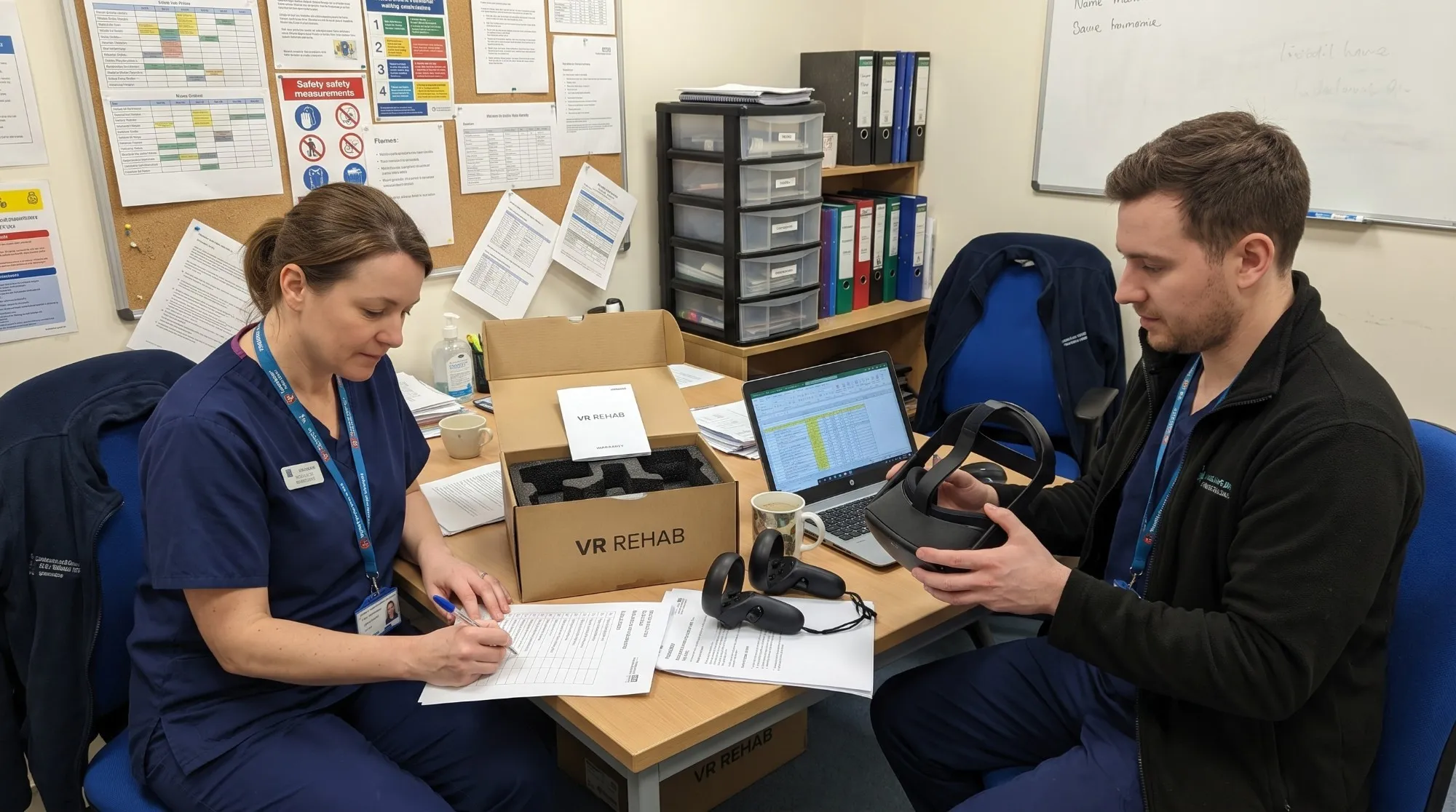
Editorial disclosure: Tech in Rehab is developed with contributions from professionals employed by Rehametrics, a company providing rehabilitation technology. Rehametrics provides no direct financial funding. No commercial platforms have been ranked or scored in this guide.
Thinking about introducing virtual reality into your rehabilitation clinic? Here’s what to look for before choosing a system, from clinical evidence and patient suitability to everyday use and costs.
Virtual reality is becoming an increasingly common tool in rehabilitation. But with different systems, technologies and therapeutic approaches available, choosing the right solution is not always straightforward.
Some platforms focus on motor rehabilitation, while others support cognitive training, balance or functional activities. They can also differ significantly in how exercises are adapted, how patient progress is recorded and how easily they fit into clinical practice.
The best VR rehabilitation system is not necessarily the one with the most exercises or the latest headset. It is the one that fits your patients, clinical goals and working environment.
What should you look for in a VR rehabilitation system?
Before comparing products, consider these six questions:
| What to check | Why it matters |
|---|---|
| 1. Patient suitability | Does it support the conditions, abilities and rehabilitation goals of your patients? |
| 2. Clinical evidence | Are there published studies supporting its use, ideally involving the specific platform? |
| 3. Therapy personalisation | Can therapists adjust exercises and track progress? |
| 4. Safety and compliance | Is the system appropriate for clinical use, with clear safety procedures and relevant regulatory documentation? |
| 5. Ease of use | Can your team integrate it into daily therapy without unnecessary complexity? |
| 6. Cost and support | What are the total costs, and what training and technical assistance are included? |
No single system will be the best choice for every rehabilitation setting. A neurological rehabilitation hospital may have different needs from an outpatient physiotherapy clinic or a residential care centre.
The following sections explain how to evaluate each area, which questions to ask providers and how to test a system before making a decision.
1. Is the system suitable for your patients?
Start with your patients, not the technology.
A VR platform may offer an impressive range of exercises, but that does not necessarily mean it is appropriate for the people you treat.
For example, a service working primarily with people recovering from stroke may need activities targeting upper-limb movement, balance or coordination. A clinic treating people with Parkinson’s disease may have different priorities, while a service supporting older adults may place greater emphasis on accessibility, tolerance and supervision.
Consider:
- Clinical conditions: Which patient groups and rehabilitation goals is the system designed to support?
- Physical abilities: Can exercises be adapted for patients with limited mobility or who need to remain seated?
- Cognitive abilities: Are the instructions and interactions appropriate for patients with attention, memory or comprehension difficulties?
- Visual and sensory needs: Can patients comfortably see, hear and interact with the activities?
- Tolerance: What happens if a patient experiences dizziness, nausea, fatigue or discomfort?
It is also important to understand the type of virtual reality being offered.
Some systems use immersive headsets that place patients in a virtual environment. Others use screens, cameras or interactive projections. Mixed reality systems can combine digital content with a view of the physical environment.
These technologies offer different experiences and practical requirements. Their suitability depends on the patient, the task and the specific system.
Questions to ask the provider:
- Which patient groups is your system designed for?
- Can patients complete exercises while seated?
- What options are available for patients who cannot tolerate an immersive headset?
- Are there clear instructions about when the system should not be used?
Practical tip: Ask for a demonstration using a realistic patient scenario from your own clinical setting, rather than a standard promotional demo.
2. What does the clinical evidence actually show?
Clinical evidence is one of the most important areas to examine, but it can also be one of the most confusing.
Research increasingly explores how VR can support rehabilitation. For example, a 2025 Cochrane review of virtual reality for stroke rehabilitation included 190 trials involving 7,188 participants. It found evidence of small improvements in some outcomes, including upper-limb function, balance and activity, although the certainty of evidence varied [1].
These findings are encouraging. However, they do not mean that every VR rehabilitation platform delivers the same results.
Evidence supporting VR as a therapeutic approach is not the same as evidence supporting a specific product.
When comparing platforms, distinguish between:
- Research on VR in general: Studies examining virtual reality rehabilitation across different technologies.
- Research using a particular platform: Studies that evaluate a named system or its specific exercises.
- Clinical outcomes: Changes in motor function, balance, independence or other relevant measures.
- Engagement and usability: Whether patients enjoy the experience, complete sessions or find the system easy to use.
All these findings can be useful, but they answer different questions. Increased engagement, for example, does not automatically demonstrate better functional recovery.
Pay attention to the patient population, the type of VR used, the comparison treatment and the outcomes measured.
Questions to ask the provider:
- Are there published studies involving your platform?
- What clinical outcomes were measured?
- Were the studies conducted independently?
- Are the findings relevant to the patients we treat?
Practical tip: Ask for links to published papers, preferably with a DOI or PubMed record. Be cautious when clinical claims rely only on general VR research without evidence involving the specific system.
3. Can therapists personalise exercises and monitor progress?
Technology should support clinical decision-making, not replace it.
A useful rehabilitation platform should allow professionals to select appropriate activities, adapt the difficulty and monitor how patients respond.
The level of control can vary significantly between systems.
Exercise personalisation
Check whether therapists can adjust:
- Exercise difficulty and movement requirements.
- Session duration, repetitions or activity intensity.
- The type of task and therapeutic objective.
- The level of assistance or supervision needed.
- Activities as the patient’s abilities change.
Some platforms provide automatic difficulty adjustments. These may be useful, but clinicians should understand how they work and whether they can override them.
Patient progress and reporting
Digital platforms can record information such as completed exercises, session duration, movement performance or task accuracy.
But more data does not always mean better clinical information.
Consider whether the system provides metrics that are understandable, relevant and useful for your rehabilitation goals.
A platform might report faster task completion or better accuracy within an exercise. These results can help monitor performance, but they should not automatically be interpreted as improvements in everyday function.
Questions to ask the provider:
- Can therapists create or adjust individual treatment plans?
- What information is recorded after each session?
- Can we review changes over time?
- Can we export reports or share relevant information with our clinical team?
- Have the platform’s measurements been validated?
Practical tip: During the demonstration, ask the provider to show a complete patient journey: selecting an exercise, adjusting its difficulty, completing a session and reviewing the results.
4. Is the system safe and appropriate for clinical use?
Safety should be considered before introducing any new technology into patient care.
Although VR can be suitable for many rehabilitation activities, some patients may experience symptoms such as dizziness, nausea, eyestrain, fatigue or discomfort [3].
Other considerations include balance difficulties, falls risk, the physical space needed and the level of supervision required.
Check whether the provider offers clear instructions covering:
- Patient selection and situations in which the system should not be used.
- Recommended supervision and safe positioning.
- Managing discomfort or adverse reactions.
- Stopping or modifying exercises when needed.
- Equipment cleaning and maintenance.
Medical device regulation in Europe
If you work in the European Union, it is also important to understand whether the product falls under the EU Medical Device Regulation (MDR) [4].
Not every VR application is automatically a medical device. Classification depends on the manufacturer’s intended purpose and the applicable regulatory requirements [5].
For systems marketed for a medical purpose, ask the provider for the relevant documentation, including the intended purpose, regulatory classification and applicable conformity information.
A CE mark alone should not be treated as proof that a platform will produce better outcomes for your specific patients.
Patient data and privacy
Rehabilitation platforms may collect sensitive patient information, including health-related data.
If your clinic operates in the EU, check how personal data are collected, stored, accessed and protected under the GDPR [8].
The responsibilities of the provider and healthcare organisation depend on their respective roles in processing the data.
Questions to ask the provider:
- What safety guidance and contraindications are documented?
- What regulatory status applies to the product?
- Where are patient data stored?
- Who can access the information?
- What happens to patient data if we stop using the service?
Practical tip: Request the relevant safety, regulatory and data protection documents before making a purchasing decision.
5. Will the technology fit into everyday clinical practice?
Even a clinically promising system may struggle if it is difficult to use in a busy rehabilitation environment.
Consider what happens before, during and after a typical session.
Before therapy: How long does it take to prepare the equipment, select the patient and start the exercise?
During therapy: Can the therapist easily monitor the patient, adjust the activity and intervene when needed?
After therapy: Is it easy to review the results, document the session and prepare for the next patient?
Also consider practical requirements such as available space, internet connectivity, charging, cleaning, storage and shared equipment.
Staff training and technical support
Your team should feel confident using the system.
Ask what training is included, whether new staff can receive additional training and how technical issues are resolved.
If a headset or computer stops working, how quickly can the clinic get help?
Questions to ask the provider:
- How long does initial setup take?
- What training is included?
- Can several therapists use the same system?
- What happens when there is a technical problem?
- Can we speak to another clinic already using the platform?
Practical tip: Involve at least two or three clinicians in the evaluation. Their feedback may reveal practical problems that are not obvious during a demonstration.
6. What will the VR rehabilitation system really cost?
When comparing VR platforms, the subscription fee or initial equipment price is only part of the picture.
Depending on the system, you may need to consider:
| Cost | What to check |
|---|---|
| Hardware | Headsets, computers, cameras, controllers or other equipment |
| Software | Licence fees, subscriptions and available features |
| Training | Initial training and onboarding for new staff |
| Maintenance | Repairs, updates, replacements and technical assistance |
| Staff time | Time needed for setup, supervision and administration |
| Future expansion | Additional licences, users, devices or clinical modules |
Some systems may appear inexpensive initially but require additional equipment or staff time. Others may have higher upfront costs but include more training and support.
The most useful question is not simply “Which platform is cheapest?”
It is “Which system offers appropriate clinical capabilities at a sustainable total cost for our service?”
Research into the economic value of VR rehabilitation remains limited and depends heavily on the systems and care settings studied. A 2024 systematic review examined economic evidence relating to robotic and VR rehabilitation technologies in neurological disorders [7].
Avoid assuming that a platform will automatically reduce costs or increase clinical capacity without assessing how it will be used in your setting.
VR rehabilitation platform comparison checklist
Once you have identified two or three potential solutions, use the following checklist to compare them.
| Evaluation area | What to verify |
|---|---|
| Patient suitability | Relevant patient groups, clinical goals and accessibility |
| Clinical evidence | Published research and relevance to your patients |
| Therapy personalisation | Exercise selection, difficulty and therapist control |
| Progress monitoring | Useful metrics, reports and data export |
| Safety and regulation | Instructions, contraindications and regulatory documentation |
| Ease of use | Setup time, workflow and staff experience |
| Training and support | Onboarding, technical support and maintenance |
| Costs | Hardware, licensing, training and ongoing expenses |
For each area, record whether the platform meets your needs, partially meets them or requires further clarification.
You can also identify essential requirements that a platform must meet before it is considered further.
For example, a service may require a particular regulatory status, accessibility feature or data protection arrangement before proceeding.
There is no universally validated score that determines the best VR rehabilitation platform for every clinic. The purpose of this checklist is to support a more consistent and transparent decision.
Download the printable checklist
Take the checklist into your next demonstration or procurement call. The free three-page PDF includes the six areas to check, the questions to ask every provider, a table to compare up to three platforms and a pilot record.
Download the VR rehabilitation platform checklist (PDF, 3 pages)
How to test a VR rehabilitation system before buying
A product demonstration can help you understand how a system works. A short clinical pilot can reveal whether it works for your team.
Before making a final decision, consider testing the platform in your own rehabilitation environment.
Step 1: Define your goals
Be clear about what you want to achieve.
For example:
- Introduce new activities for upper-limb rehabilitation.
- Provide more varied balance exercises.
- Support patient engagement during therapy.
- Improve the way sessions are documented.
Step 2: Choose suitable patients and clinicians
Select a small group that reflects your intended use of the platform, with appropriate clinical selection and supervision.
Include professionals who would use the technology regularly.
Step 3: Evaluate practical performance
During the pilot, record:
- Time needed to prepare and complete sessions.
- Ease of use for therapists and patients.
- Patient comfort and tolerance.
- Technical problems or interruptions.
- Usefulness of exercise adjustments and reports.
- Any adverse events.
Where appropriate, continue using your established clinical outcome measures [6]. A short pilot may be useful for assessing feasibility and usability, but it will rarely establish clinical effectiveness.
Step 4: Review the results
Ask the clinical team:
- Did the platform meet our original objectives?
- Was it appropriate for the patients who used it?
- What worked well, and what created difficulties?
- What additional training or support would we need?
- Is the overall cost justified for our setting?
Use the findings to make a decision based on your clinical priorities, rather than the initial product demonstration alone.
Final thoughts: choose the system that fits your clinical needs
VR rehabilitation technology offers new ways to deliver therapeutic activities, monitor performance and engage patients.
But choosing a platform should involve more than comparing headsets, exercise libraries or promotional claims.
Focus on the patients you treat, the clinical goals you want to achieve and how the system will work in everyday practice.
Ask for evidence, involve your rehabilitation team and test the technology before committing.
A thoughtful evaluation will help you select a system that supports your clinical work rather than adding unnecessary complexity.
Looking for a more detailed product comparison? Explore our upcoming guide to VR rehabilitation platforms, including their features, clinical applications and practical differences.
References and further reading
- Laver KE, Lange B, George S, Deutsch JE, Saposnik G, Chapman M, Crotty M. Virtual reality for stroke rehabilitation. Cochrane Database Syst Rev 2025;6:CD008349. DOI: 10.1002/14651858.CD008349.pub5
- Zhang J, et al. Effects of virtual reality with different modalities on upper limb recovery: a systematic review and network meta-analysis. Front Neurol 2025;16:1544135. DOI: 10.3389/fneur.2025.1544135
- Saredakis D, et al. Factors associated with virtual reality sickness in head-mounted displays: a systematic review and meta-analysis. Front Hum Neurosci 2020;14:96. DOI: 10.3389/fnhum.2020.00096
- Regulation (EU) 2017/745 on medical devices. OJ L 117, 5 May 2017. eur-lex.europa.eu/eli/reg/2017/745/oj
- Medical Device Coordination Group. MDCG 2019-11 rev.1: Guidance on qualification and classification of software under the MDR and IVDR. European Commission, June 2025. health.ec.europa.eu
- Kwakkel G, et al. Standardized measurement of sensorimotor recovery in stroke trials: consensus-based core recommendations from the Stroke Recovery and Rehabilitation Roundtable. Int J Stroke 2017;12(5):451-461. DOI: 10.1177/1747493017711813
- Cano-de-la-Cuerda R, et al. Economic cost of rehabilitation with robotic and virtual reality systems in people with neurological disorders: a systematic review. J Clin Med 2024;13(6):1531. DOI: 10.3390/jcm13061531
- Regulation (EU) 2016/679: General Data Protection Regulation (GDPR). OJ L 119, 4 May 2016. eur-lex.europa.eu/eli/reg/2016/679/oj
This article is for educational purposes and does not replace professional clinical judgement or product-specific safety guidance.
Frequently asked questions
What is the difference between a VR headset and a clinical VR rehabilitation platform?
A VR headset is a piece of hardware used to experience virtual environments. A clinical rehabilitation platform combines hardware and software intended to support specific therapeutic activities. Depending on the product, it may also include exercise personalisation, patient management, progress monitoring and clinical reporting.
Are VR rehabilitation systems effective?
Research suggests that certain VR interventions can support rehabilitation outcomes in specific patient groups, including people recovering from stroke. However, effectiveness varies by condition, intervention, outcome and study quality. Evidence about VR as a general approach should not be treated as proof that every commercial platform is effective.
Can older adults use VR rehabilitation?
Some older adults can use VR rehabilitation successfully, but suitability should be assessed individually. Consider vision, balance, cognition, physical abilities, comfort and the type of VR system. Appropriate supervision and gradual introduction may be necessary.
Does a VR rehabilitation platform need a CE mark?
In the EU, a product that qualifies as a medical device must meet the applicable regulatory requirements, including CE marking. Whether a particular VR product is classified as a medical device depends on its intended purpose and applicable rules. Ask the manufacturer for documentation covering the product's intended medical use.
How do I compare different VR rehabilitation platforms?
Start with patient suitability, clinical evidence, therapy personalisation, safety, workflow and total cost. Compare the information provided by manufacturers, request supporting documents and, where possible, test suitable systems with your clinical team before making a decision.