Exergames and apps for fall prevention: do they reduce falls, or just improve balance?
What randomised trials show when exergames and exercise apps are judged on falls, not balance scores, in older people living at home or in care.
Disclosure: Tech in Rehab is developed with contributions from professionals employed by Rehametrics, which sells rehabilitation technology. Rehametrics provides no direct financial funding. None of the trials discussed in this article tested a Rehametrics product.
The main finding
Exercise prevents falls in older people. That isn’t in doubt: a Cochrane review of community trials found 23% fewer falls with exercise than with control (high-certainty evidence) [1]. The open question is whether technology can deliver that exercise, at home and over time, and still reduce falls.
A 2026 meta-analysis by Eost-Telling and colleagues tackled this by looking at falls themselves rather than balance scores [2]. Exergames reduced the rate of falls compared with active control activities not designed to prevent falls (moderate certainty), and reduced the number of people who fell over 12 months compared with usual care, a result that rests on one large trial. Against usual care, the pooled reduction in fall rate was not statistically significant.
For clinicians, the most useful reading is the authors’ own: exergames may work as a complement to established fall prevention exercise, not a replacement for it [2].
Why falls, not balance
Many reviews have found that exergames improve balance tests, mobility or fear of falling. Those are useful intermediate outcomes, but they don’t guarantee fewer falls. The largest trial in this field shows the gap well: the falls rate dropped, while the secondary measures of physical and cognitive function did not improve [3].
Fall prevention trials are expected to count falls prospectively, ideally for 12 months, because effects can take time to appear and depend on people continuing to exercise.
The review
- Trials: 9 randomised controlled trials, 1,385 participants, mean age 73, searched to February 2025 [2].
- Participants: varied. Four trials recruited people with Parkinson’s disease, three recruited people with a history of falls and one included mild cognitive impairment.
- Interventions: four used the Nintendo Wii, two used Microsoft Kinect (one with tailored strength and balance games, one with a treadmill and a virtual environment), two used dance mats and one used a stepping mat with bespoke games. All were screen-based.
- Dose: 6 to 52 weeks, two or three sessions a week, 15 to 60 minutes per session.
- Comparators, analysed separately: usual care, exercise known to prevent falls, and active controls not designed to prevent falls.
- Certainty: rated with GRADE, mostly low; imprecision and inconsistency were the main reasons.
What it found
| Comparison | Outcome | Result (95% CI) | Trials | Certainty |
|---|---|---|---|---|
| vs usual care | Rate of falls | IRR 0.60 (0.35 to 1.01) | 3 | Low |
| vs usual care | Fallers at 12 months | RR 0.75 (0.61 to 0.92) | 1 | Low* |
| vs exercise known to prevent falls | Rate of falls | IRR 0.41 (0.27 to 0.62) | 3 | Low |
| vs controls not designed to prevent falls | Rate of falls | IRR 0.58 (0.44 to 0.77) | 3 | Moderate |
*The review’s GRADE table rates this outcome low certainty; its abstract describes it as moderate.
Against usual care, the pooled estimate pointed to fewer falls, but the interval included no effect and heterogeneity was high (I² 86%). The 12-month result on fallers comes from a single trial.
Against proven exercise, the reduction looks large, but it comes from three small trials with 210 participants in total and short follow-up. A result like that needs confirming before anyone concludes that a game beats an established programme.
Injurious falls were reported by one trial only: 19% fewer people with an injurious fall, with an interval that included no effect (RR 0.81, 0.61 to 1.08).
Safety: no serious intervention-related adverse events were reported. One trial recorded a non-injurious fall during a supervised session.
The review’s funding came from the UK’s National Institute for Health and Care Research. One author co-founded an exergame company, and several authors had written included trials; the review states that they took no part in data extraction, analysis or quality assessment.
Two trials worth knowing
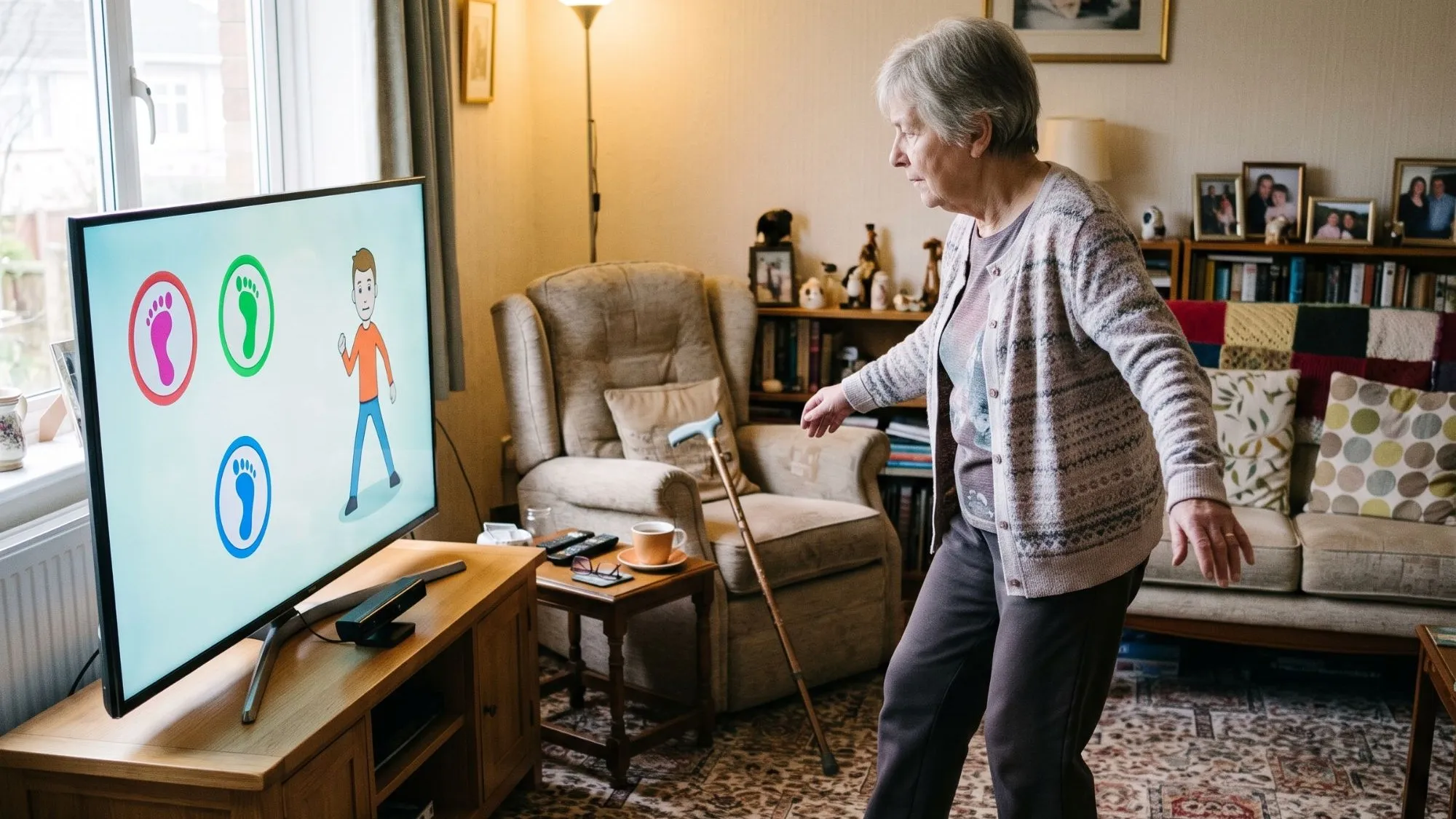
smart±step (Sturnieks 2024). 769 people aged 65 and over living independently were randomised to a stepping game on a mat at home, a seated cognitive game, or an education booklet, for 12 months [3]. The stepping game reduced the rate of falls by 26% (IRR 0.74, 0.56 to 0.98); the seated cognitive game did not significantly reduce falls. The target was 120 minutes a week, and only 0.6% of participants met it across the whole year [2]. The trial excluded people with neurological or cognitive impairment.
StandingTall (Delbaere 2021). This is not a game but a tablet app that prescribes and progresses balance exercises [4]. In 503 people aged 70 and over, the 12-month primary outcomes were not statistically different. Over two years, the intervention group had 16% fewer falls (IRR 0.84, 0.72 to 0.98) and 20% fewer people with an injurious fall (RR 0.80, 0.66 to 0.98), as secondary outcomes. At 12 months, 68% of the intervention group were still exercising, at a median of about two hours a week. A separate economic evaluation found it was potentially cost-effective in some subgroups, not across all older people [5].
A 2026 meta-analysis of mobile health apps for fall prevention (9 trials, 3,437 participants) found an 11% lower risk of falling over 12 months (RR 0.89, 0.81 to 0.98), with no significant reduction in fall rate [6].
How to interpret and apply the findings
What the evidence supports:
- Exergames reduced falls compared with activities not designed to prevent falls (moderate certainty), and the largest home trial reduced the rate of falls compared with an education booklet.
- An app-delivered balance programme reduced falls and injurious falls over two years, though not at its 12-month primary endpoint.
- Whether exergames work better than established fall prevention exercise remains uncertain.
Our suggestions for integrating these tools. These are editorial guidance based on general fall prevention practice. The studies did not test them.
- Treat the technology as a way of delivering balance training. Check that the tasks actually challenge balance (stepping, weight shifting, a narrower base) and that difficulty progresses.
- Keep strength and functional work in the programme alongside the game or app.
- Consider who can use it safely: the home trials recruited people living independently, without cognitive impairment. Set it up with the person, and agree what support they will have.
- Use the session data the system records to follow the dose, and ask about falls at every review, not only about balance scores.
Limitations to keep in mind. The review rests on nine heterogeneous trials, most of them small, with follow-up of 12 months in only a few. Populations ranged from healthy community-dwellers to people with Parkinson’s disease, and the search was limited to English. Cost-effectiveness was assessed in one exergame trial: in UK assisted living, the estimate was £15,210 per QALY, with a 61% probability of cost-effectiveness at the £20,000 threshold [7].
Bottom line for clinicians
- Supported benefit: exergames have reduced falls compared with control activities in older people, and a home stepping game and an app-based balance programme each reduced falls in large trials.
- Integration opportunity: use an exergame or app to extend balance training into the home between sessions, for people who can use it safely.
- Your role: choosing tasks that challenge balance, progressing them, combining them with strength work and tracking falls over time is what turns a game into fall prevention.
For a related review in Parkinson’s disease, see Does VR improve balance in Parkinson’s disease?, and for home programmes in musculoskeletal rehab, Home exercise apps with motion tracking.
References
- Sherrington C, Fairhall NJ, Wallbank GK, Tiedemann A, Michaleff ZA, Howard K, Clemson L, Hopewell S, Lamb SE. Exercise for preventing falls in older people living in the community. Cochrane Database Syst Rev 2019;1:CD012424. DOI: 10.1002/14651858.CD012424.pub2 · PubMed 30703272
- Eost-Telling C, McGarrigle L, Shi C, Money A, Yang Y, Lazo Green K, Ahmed S, Christie R, Aminu A, Delbaere K, de Bruin ED, Stanmore E, Todd C. Exergaming interventions for preventing falls and injurious falls in older people: systematic review and meta-analysis of randomized controlled trials. JMIR Aging 2026;9:e89807. DOI: 10.2196/89807 · PubMed 42536979 · Full text (PMC)
- Sturnieks DL, Hicks C, Smith N, Ratanapongleka M, Menant J, Turner J, Lo J, Chaplin C, Garcia J, Valenzuela MJ, Delbaere K, Herbert RD, Sherrington C, Toson B, Lord SR. Exergame and cognitive training for preventing falls in community-dwelling older people: a randomized controlled trial. Nat Med 2024;30:98-105. DOI: 10.1038/s41591-023-02739-0 · PubMed 38228913
- Delbaere K, Valenzuela T, Lord SR, Clemson L, Zijlstra GAR, Close JCT, Lung T, Woodbury A, Chow J, McInerney G, Miles L, Toson B, Briggs N, van Schooten KS. E-health StandingTall balance exercise for fall prevention in older people: results of a two year randomised controlled trial. BMJ 2021;373:n740. DOI: 10.1136/bmj.n740 · PubMed 33824131
- Ambrens M, van Schooten KS, Lung T, Clemson L, Close JCT, Howard K, Lord SR, Zijlstra GAR, Tiedemann A, Valenzuela T, Vandelanotte C, Chow J, McInerney G, Miles L, Woodbury A, Delbaere K. Economic evaluation of the e-Health StandingTall balance exercise programme for fall prevention in people aged 70 years and over. Age Ageing 2022;51(6):afac130. DOI: 10.1093/ageing/afac130 · PubMed 35679193
- Bindawas SM, Vennu V, Almarwani M, Alsaleh HM, Alsaad SM. Effectiveness of mobile health application-based interventions for fall prevention in community-dwelling older adults: a systematic review and meta-analysis of randomized controlled trials. Sensors 2026;26(3):864. DOI: 10.3390/s26030864 · PubMed 41682379
- Stanmore EK, Mavroeidi A, de Jong LD, Skelton DA, Sutton CJ, Benedetto V, Munford LA, Meekes W, Bell V, Todd C. The effectiveness and cost-effectiveness of strength and balance Exergames to reduce falls risk for people aged 55 years and older in UK assisted living facilities: a multi-centre, cluster randomised controlled trial. BMC Med 2019;17:49. DOI: 10.1186/s12916-019-1278-9 · PubMed 30813926
Frequently asked questions
Do exergames reduce falls in older people?
Probably, in some settings. A 2026 meta-analysis of 9 randomised trials (1,385 participants) found fewer falls with exergames than with control activities not designed to prevent falls (IRR 0.58, moderate certainty). Against usual care, the pooled reduction was not statistically significant, although the largest trial, a home stepping game, reduced the rate of falls by 26% over 12 months.
Are exergames better than conventional fall prevention exercise?
This hasn't been shown reliably. Three small trials (210 participants) compared exergames with exercise known to prevent falls and found fewer falls with exergames, but the certainty is low and the follow-up short. The review authors recommend exergames as a complement to established programmes, not a replacement.
Does better balance mean fewer falls?
Not necessarily, and the two don't always move together. In the largest exergame trial, the falls rate dropped while secondary measures of physical and cognitive function did not improve. That is why falls, recorded prospectively, are the outcome that matters in fall prevention trials.
Can older people use these programmes at home without supervision?
In the trials, they rarely did so entirely alone. Every exergame study in the 2026 review provided professional support, and seven of nine supervised sessions throughout. The two home-based programmes still began with set-up and training, followed by technical support. Most trials excluded people with cognitive impairment.