Does VR improve balance in Parkinson's disease?
A 2025 meta-analysis of 28 trials found screen-based VR improved balance more than conventional therapy in Parkinson's disease. What it means for practice.
The main finding
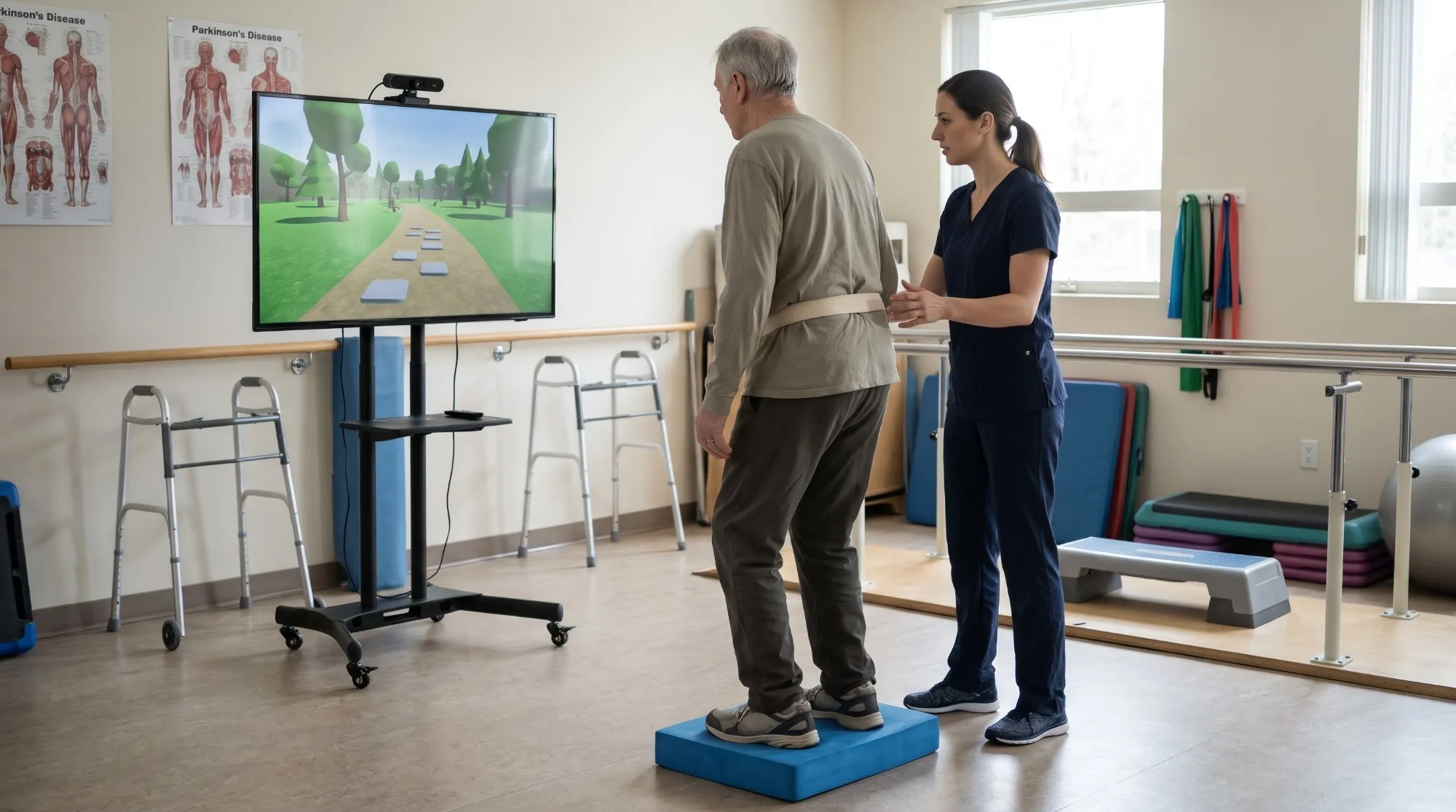
In people with mild to moderate Parkinson’s disease, screen-based VR exergames improved balance more than conventional therapy. That is the central result of a 2025 meta-analysis by Lheureux and colleagues at the Université catholique de Louvain [1]. The effect was small and the authors rate the evidence low certainty. For mobility, they found no statistically significant difference between VR and conventional therapy.
For clinicians, the practical reading is in the authors’ own recommendation: use VR as a complement to conventional therapy for balance, for a sufficient dose, and choose exergames by what they train rather than by the type of system [1]. Our four-minute video summary covers the same review.
The study
- Design: systematic review and meta-analysis of randomised controlled trials, registered in PROSPERO, published in Annals of Physical and Rehabilitation Medicine [1].
- Trials: 28 trials from 12 countries, with 1,151 participants. 23 had data that could be pooled.
- Participants: mean Hoehn and Yahr stage between 1.4 and 3.4, so mostly mild to moderate disease.
- Intervention: VR exergames, alone or added to conventional therapy. All of them were non-immersive, on a screen, either built for rehabilitation (15 trials) or commercial consoles such as the Nintendo Wii or Xbox Kinect (13 trials).
- Comparators: conventional physiotherapy or occupational therapy, balance training, treadmill walking and similar programmes. One trial used no treatment.
- Outcomes: balance (Berg Balance Scale, Sensory Organization Test, Tinetti balance subscale, Mini-BESTest) and mobility (Timed Up and Go, Functional Gait Assessment, Dynamic Gait Index), measured at the end of treatment.
- Dose: an average of 18.8 hours of training in total.
- Analysis: the final pooled estimates excluded trials at high risk of bias and statistical outliers. The authors rated certainty with GRADE, and we report their ratings.
We worked from the author manuscript in UCLouvain’s open-access repository [1].
What it found
| Outcome | SMD (95% CI) | Trials | Participants | Certainty (authors) |
|---|---|---|---|---|
| Balance: VR vs conventional therapy | 0.42 (0.19 to 0.65) | 11 | 630 | Low |
| Mobility: VR vs conventional therapy | 0.18 (−0.03 to 0.40) | 10 | 591 | Moderate |
Balance. VR improved balance more than conventional therapy. An SMD of 0.42 is a small effect by the usual rule of thumb. Because it pools different scales, it can’t be translated into points on the Berg Balance Scale or checked against a minimal clinically important difference. The certainty is low because results varied between trials and the effect was small.
Mobility. The review found no statistically significant difference (P = 0.09). That is not evidence of equivalence, and it is not evidence that VR adds nothing. The authors offer a likely explanation: the exergames in these trials trained balance in a small space and didn’t include walking, while the mobility tests measure gait and transfers [1]. A function that isn’t trained is unlikely to improve.
Dose. Programmes of 15 hours or more improved balance more than conventional therapy (SMD 0.49). Shorter programmes did not show a clear effect. The difference between the two subgroups was not statistically significant, so this is a signal, not a proven dose threshold.
Disease severity. The balance effect was seen at both lower and higher Hoehn and Yahr stages, with no significant difference between them. Few participants had advanced disease.
Rehabilitation systems and consoles
Systems built for rehabilitation and commercial consoles gave similar balance and mobility results. The authors also counted how many of 15 neurorehabilitation principles each programme applied. The numbers were similar too: 7.3 for rehabilitation systems and 6.9 for consoles. One difference stood out. Task-specific practice, meaning training in situations close to daily life, appeared in 57% of the rehabilitation-system trials and in none of the console trials [1]. Rhythmic cueing, a common tool in Parkinson’s physiotherapy, appeared in fewer than half of the programmes of either type.
This finding concerns clinical outcomes on the scales measured. It doesn’t settle questions the review did not study, such as how far a system can be adapted to the patient, how much control it gives the therapist, what data it records, or how well it fits into a service. Those are reasonable selection criteria, but the review doesn’t show that any of them changes outcomes.
What two other reviews add
Dose and clinical relevance. Xie and Dai pooled 31 randomised trials (1,110 participants) and reported results in original units [2]. Across the pooled trials, VR training improved the Timed Up and Go by 3.69 seconds and balance confidence (ABC scale) by 11.8 points, and both changes met the minimal clinically important difference. VR used on its own improved the Timed Up and Go without reaching that threshold, and the authors highlight clinical relevance particularly when VR was combined with physical therapy. A meta-regression linked the best Timed Up and Go results to sessions of 21 to 40 minutes, 4 to 7 times a week, for 6 to 8 weeks. We had access to the abstract only, so we could not check the subgroup details.
Headsets. All the trials in the main review used screens. Ishaq and colleagues looked at head-mounted VR and found 11 studies with 278 participants [3]. Randomised trials showed better quality of life on the PDQ-39 than conventional therapy. The balance and gait findings came mainly from before-and-after comparisons, so evidence for headsets in Parkinson’s is still limited. We explain the difference between the two formats in Immersive vs non-immersive VR.
How to interpret and apply the findings
What the evidence supports:
- Screen-based VR exergames improved balance more than conventional therapy in mild to moderate Parkinson’s disease, with a small effect and low certainty.
- The authors recommend VR as a complement to conventional therapy, for 15 hours or more, with exergames chosen for the neurorehabilitation principles they apply [1].
- For mobility, VR did not show an added benefit. Gait training still needs its own place in the programme.
Our suggestions for integrating VR well. These are editorial guidance based on general rehabilitation practice. The studies did not test them.
- Define the therapeutic goal first, for example postural control or weight shifting, and choose games whose tasks train it.
- Set difficulty and progression from your own assessment, and adjust them as the patient changes.
- Fit VR into the programme alongside gait, strength and dual-task work, rather than as a separate activity.
- Reassess with the same scale you use in clinic, such as the Berg Balance Scale or Mini-BESTest, and review the plan if the patient isn’t improving.
Our guide to choosing a VR rehabilitation system covers the implementation side: adaptation, supervision, monitoring and day-to-day use.
Limitations to keep in mind. Only 5 of the 28 trials had a low risk of bias, and no trial blinded participants or therapists. Results apply to non-immersive VR in mild to moderate disease. Outcomes were measured at the end of treatment. A few individual trials reported falls, but the review did not pool them, and it does not report adverse events. The search covered two databases plus the reference lists of earlier reviews. The authors declare no competing interests, and the work was funded by the Fondation Louvain and the Fonds Spéciaux de Recherche [1].
Bottom line for clinicians
- Supported benefit: in mild to moderate Parkinson’s disease, screen-based VR exergames improved balance more than conventional therapy, with a small effect and low certainty.
- Integration opportunity: add VR to the balance part of the programme, for at least 15 hours, choosing tasks that train postural control in situations close to daily life.
- Your role: setting the goal, choosing and progressing the exercises, and checking the response with your usual scales is what turns a balance game into balance rehabilitation.
For the evidence in stroke, see What the 2025 Cochrane review says about VR after stroke, and for the wider picture, our guide to VR in rehabilitation.
References
- Lheureux A, Lejeune T, Simons A, Gillis A, Everard G. Virtual reality effects on balance and mobility in people with Parkinson’s disease: a systematic review with meta-analysis. Ann Phys Rehabil Med 2025;68(6):101967. DOI: 10.1016/j.rehab.2025.101967 · PubMed 40253963 · Open-access manuscript (UCLouvain)
- Xie L, Dai J. Dose-response relationship of virtual reality training in Parkinson’s disease: a meta-analysis of overall motor function, functional mobility, and balance confidence. Arch Phys Med Rehabil 2026 (online ahead of print). DOI: 10.1016/j.apmr.2026.02.490 · PubMed 41819338
- Ishaq S, Shah IA, Lei WF, Lee SD, Wu BT. Effectiveness of head-mounted virtual reality rehabilitation in individuals with Parkinson’s disease: a systematic review and meta-analysis. Assist Technol 2026;38(2):187-197. DOI: 10.1080/10400435.2025.2604079 · PubMed 41503973
Frequently asked questions
Does VR improve balance in Parkinson's disease?
In a 2025 meta-analysis of 11 trials (630 participants), screen-based VR exergames improved balance more than conventional therapy, with a small effect (SMD 0.42, 95% CI 0.19 to 0.65). The authors rate the certainty as low, because results varied between trials and the effect was small.
Is VR better than conventional physiotherapy for walking and mobility in Parkinson's?
The 2025 review found no statistically significant difference for mobility (SMD 0.18, 95% CI −0.03 to 0.40; moderate certainty). That does not show the two are equivalent, and it does not show VR adds nothing. The authors note that the exergames studied did not include walking, while the mobility tests did.
Do you need a dedicated rehabilitation system, or does a games console work?
In this review, balance and mobility results did not differ between systems built for rehabilitation and commercial consoles. That answers a question about clinical outcomes only. It doesn't tell you which system is easier to adapt, supervise or monitor in your service, which are separate selection criteria.
How much VR training is needed in Parkinson's disease?
In the 2025 review, programmes of 15 hours or more improved balance more than conventional therapy, while shorter programmes did not show a clear effect, although the difference between the two subgroups was not statistically significant. The authors suggest at least 15 hours. A separate 2026 meta-regression linked the best Timed Up and Go results to sessions of 21 to 40 minutes, 4 to 7 times a week, for 6 to 8 weeks.