Immersive vs non-immersive VR: what's the difference for therapy?
Headsets, projection and screens compared for rehabilitation: what the stroke evidence shows about immersion, and how set-up, supervision and tolerance differ.
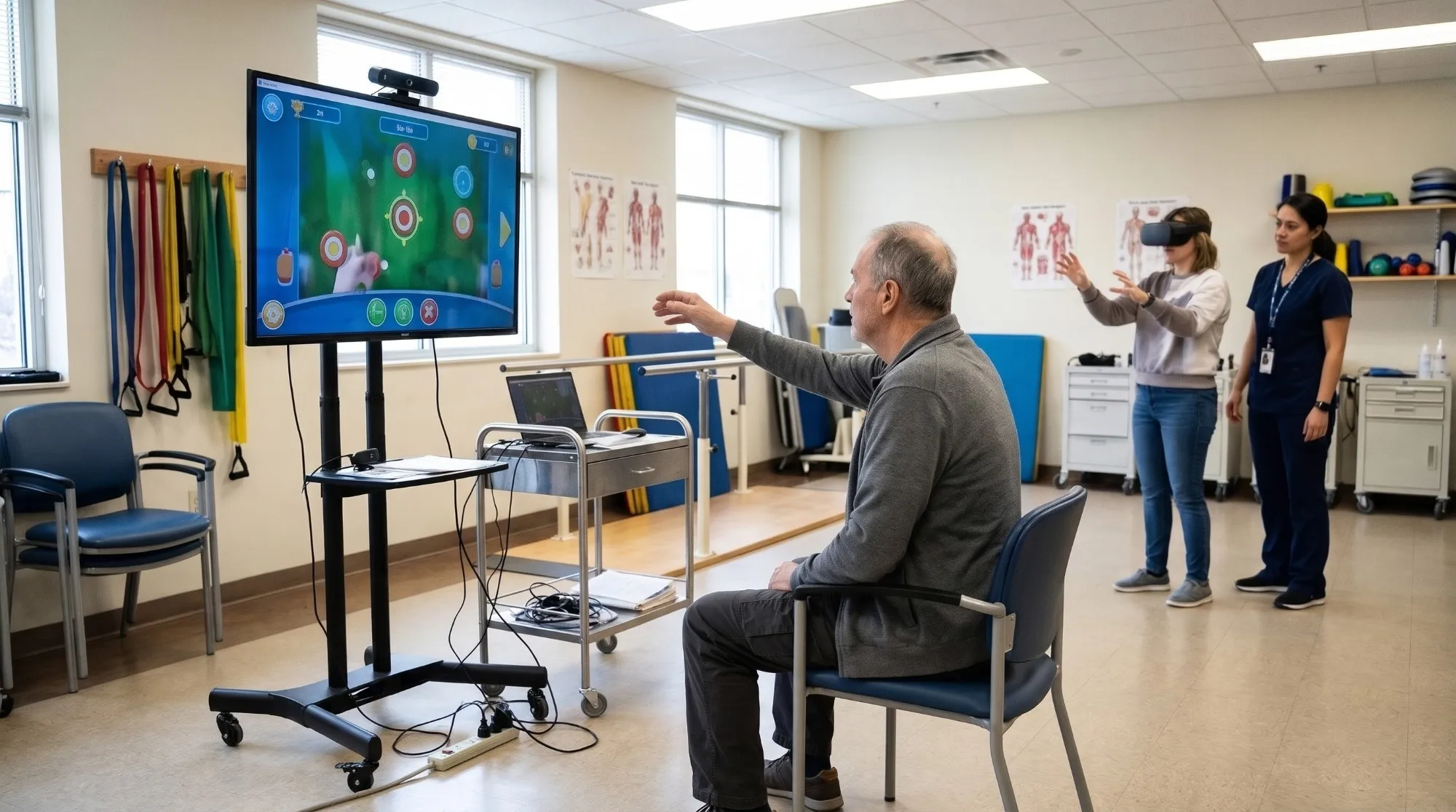
The main finding
For arm recovery after stroke, the best-studied use, both screen-based and headset VR have been associated with gains over conventional therapy. What the evidence doesn’t show is that one format is better. Most trials used screens, the comparisons between formats are indirect, and the two reviews that made them pointed in different directions [2,4].
For clinicians, the question becomes which format fits this patient, goal and service. The formats differ in set-up, supervision, space and tolerance, and those are practical differences, not proven effects on outcomes.
Three levels of immersion
VR systems are usually grouped by how much of the real world they replace:
- Non-immersive: the virtual environment appears on a monitor or TV. A camera, sensors or a controller track movement. This includes rehabilitation systems and commercial consoles.
- Semi-immersive: a large projection on a wall or the floor, or a wide display, fills more of the field of view.
- Fully immersive: a head-mounted display (a headset) replaces what the patient sees and tracks head and hand movement.
Immersion is a property of the system; presence is the user’s experience of “being there” [1]. More of one does not guarantee more of the other.
What the evidence says about clinical outcomes
All three reviews below concern upper limb recovery after stroke.
The Cochrane review: mostly screens, one small immersion signal. The 2025 Cochrane review pooled 190 randomised trials under a 2001 definition of VR that includes video gaming [2,3]. Its main upper limb finding, a slight improvement over alternative therapy at the same dose (SMD 0.20; low certainty), mostly describes non-immersive VR. In a new subgroup analysis of programmes built for rehabilitation, the few immersive trials showed a larger effect (SMD 0.68, 95% CI 0.32 to 1.04) than non-immersive ones (SMD 0.20, 0.10 to 0.30), a statistically significant difference. The authors state that, with so few immersive trials, they could not draw conclusions about how the formats compare [2].
A network meta-analysis: consoles ranked first. Zhang and colleagues pooled 34 randomised trials (1,704 participants) with dose-matched conventional therapy, comparing formats indirectly [4]. On the Fugl-Meyer upper extremity scale:
| Format vs conventional therapy | Trials | Mean difference (95% interval) |
|---|---|---|
| Kinect console | 4 | 7.27 (0.59 to 13.77) |
| Wii console | 8 | 4.53 (0.87 to 8.14) |
| Other non-immersive VR | 16 | 3.57 (1.18 to 6.01) |
| Headset VR | 6 | 4.16 (−0.02 to 8.38) |
The headset estimate was similar in size, but its interval just crossed zero. The intervals overlap widely, there is no certainty rating, and the authors note that an earlier network meta-analysis favoured immersive VR. Their remarks on cost and engagement go beyond what they measured.
An immersive-only review: small gains. Kenea and colleagues compared headset VR with conventional rehabilitation [5]. In 11 trials, the Fugl-Meyer upper extremity score improved by 3.04 points (95% CI 1.46 to 4.62), and in 5 trials the Box and Block Test improved by 2.85 blocks (0.70 to 4.99). The Action Research Arm Test showed no significant difference. Heterogeneity was high, both gains fell below the clinical thresholds the authors applied, and there was no GRADE rating. More in VR and hand dexterity after stroke: is the gain clinically meaningful?
Other conditions. Stroke results don’t transfer automatically. In Parkinson’s disease, balance evidence comes from screen-based exergames and headset evidence is more limited: see Does VR improve balance in Parkinson’s disease?
Implementation: where the formats clearly differ
This table reflects how the systems work, not trials comparing them.
| Non-immersive (screen) | Semi-immersive (projection) | Fully immersive (headset) | |
|---|---|---|---|
| What the patient sees | The room and a screen | The room and a large projected image | Only the virtual environment |
| Set-up | Usually simple | Projector and sensors; fixed installation | Headset fitting and calibration each session |
| Space | A screen and a clear area | A wall or floor area | A clear, safe area around the patient |
| Supervision | Patient can see the therapist | Shared view; suits groups | Therapist needs to watch closely; the patient cannot see the room |
| Hygiene | Shared surfaces only | Shared surfaces only | Face-contact parts need cleaning between patients |
| Evidence in stroke reviews | Most trials | Not analysed separately | Few trials |
Cybersickness. Nausea, dizziness and disorientation are the main tolerance issue with headsets. Saredakis and colleagues pooled 55 headset studies (3,016 participants) [6]. Average symptom scores were above recommended cut-offs, gaming content scored highest, and where dropouts were reported, 15.6% of participants stopped because of sickness. The review excluded clinical samples and participants averaged 24 years old, so the figures may not apply to patients.
Adverse events in stroke trials. Across formats, they were few and mild, mostly short-lived dizziness, headache or pain, but only 59 of the 190 Cochrane trials monitored them [2].
Patient suitability. A headset may be harder for people with significant cognitive impairment, visual or vestibular problems, limited head control or anxiety about losing sight of the room.
Interaction. In the 23 immersive studies reviewed by Kenea and colleagues, 15 (65%) used hand tracking rather than controllers [5]. Which suits a patient depends on hand function.
How to interpret and apply the findings
What the evidence supports:
- After stroke, VR may slightly improve arm function compared with alternative therapy (low certainty), mostly on evidence from screen-based systems [2].
- Headset VR has shown small gains over conventional rehabilitation, below the authors’ clinical thresholds and without a certainty rating [5].
- No review establishes that one level of immersion works better: the one significant difference rested on 4 small trials.
Our suggestions for choosing a format. These are editorial guidance based on general rehabilitation practice. The studies did not test them.
- Define the therapy goal and outcome measure first, and check the system records data that map to it.
- Screen for tolerance, cognition, vision, balance and head control; prefer a screen or projection system when a headset is likely to be a barrier.
- With a headset, start with short, seated sessions and a clear way to stop immediately.
- Count supervision, set-up and cleaning time, and reassess with your usual scales.
For a structured comparison of platforms, use our guide to choosing a VR rehabilitation system.
Limitations to keep in mind. The comparison between formats rests on indirect evidence, few headset trials and no certainty ratings. Semi-immersive systems were not analysed separately, the evidence concerns the upper limb after stroke, and no specific product was evaluated.
Bottom line for clinicians
- Supported benefit: after stroke, VR may slightly improve arm function compared with other therapy (low certainty), mostly with screens; headsets have shown small gains in their own trials.
- Integration opportunity: match the format to the patient: a screen or projection for someone who needs to see the room, a headset for someone who tolerates it and whose task suits it.
- Your role: setting the goal, screening for tolerance, supervising and checking the response with your usual measures is what turns any format into rehabilitation.
For background on VR in rehabilitation, see our therapist’s guide, and for the full stroke evidence, What the 2025 Cochrane review says about VR after stroke.
References
- Slater M, Wilbur S. A Framework for Immersive Virtual Environments (FIVE): speculations on the role of presence in virtual environments. Presence 1997;6(6):603-616. DOI: 10.1162/pres.1997.6.6.603
- Laver KE, Lange B, George S, Deutsch JE, Saposnik G, Chapman M, Crotty M. Virtual reality for stroke rehabilitation. Cochrane Database Syst Rev 2025;6:CD008349. DOI: 10.1002/14651858.CD008349.pub5 · PubMed 40537150
- Wade DT. Virtual reality for stroke rehabilitation: time to rethink? Cochrane Editorial 2025, ED000174. DOI: 10.1002/14651858.ED000174 · PubMed 40642842
- Zhang J, Liu M, Yue J, Yang J, Xiao Y, Yang J, Cai E. Effects of virtual reality with different modalities on upper limb recovery: a systematic review and network meta-analysis on optimizing stroke rehabilitation. Front Neurol 2025;16:1544135. DOI: 10.3389/fneur.2025.1544135 · PubMed 40236896
- Kenea CD, Abessa TG, Lamba D, Bonnechère B. Immersive virtual reality in stroke rehabilitation: a systematic review and meta-analysis of its efficacy in upper limb recovery. J Clin Med 2025;14(6):1783. DOI: 10.3390/jcm14061783 · PubMed 40142592
- Saredakis D, Szpak A, Birckhead B, Keage HAD, Rizzo A, Loetscher T. Factors associated with virtual reality sickness in head-mounted displays: a systematic review and meta-analysis. Front Hum Neurosci 2020;14:96. DOI: 10.3389/fnhum.2020.00096 · PubMed 32300295
Frequently asked questions
What is the difference between immersive and non-immersive VR?
Non-immersive VR shows the virtual environment on a screen, and the patient stays aware of the room. Immersive VR uses a head-mounted display (headset) that replaces what the patient sees and tracks head movement. Semi-immersive systems sit in between, usually with large projections or wide displays.
Is immersive VR more effective than non-immersive VR in rehabilitation?
Current evidence doesn't answer this. In the 2025 Cochrane review on stroke, 4 small trials of immersive, rehabilitation-specific VR showed a larger effect on arm function than 39 non-immersive trials, but the authors said there were too few immersive trials to draw conclusions. A 2025 network meta-analysis ranked screen-based consoles highest. Both comparisons were indirect.
Does immersive VR cause more side effects?
Cybersickness, a mix of nausea, dizziness and disorientation, is a recognised issue with headsets. A 2020 meta-analysis of 55 headset studies found symptom scores above recommended cut-offs on average, but it excluded patient samples and its participants averaged 24 years old, so the risk in patients is uncertain. In stroke trials that monitored adverse events, they were few and mild.
Which type of VR should a clinic choose?
It depends on the patients, the goals and the setting. Consider whether patients can tolerate a headset, how much supervision and space you have, how devices will be cleaned, and whether the system records outcomes you already use. Evidence for VR in general does not show that any specific product works.