VR and hand dexterity after stroke: is the gain clinically meaningful?
A meta-analysis found a small average gain on the Box and Block Test after immersive VR in stroke. We explain the numbers, the thresholds and the limits.
The main finding
In people after stroke, immersive virtual reality (imVR) delivered through a head-mounted display gave a small average extra gain in gross hand dexterity over conventional rehabilitation. That is the result of a 2025 meta-analysis by Kenea and colleagues [1]. On the Box and Block Test (BBT), the imVR groups moved, on average, almost three more blocks per minute at the end of treatment: a statistically significant difference, smaller than the thresholds used to judge change in an individual, from five trials that disagreed substantially. On the Action Research Arm Test (ARAT), the difference was not statistically significant. Fine dexterity was not pooled.
The authors’ own reading is that clinicians should consider imVR “as a complementary tool within a more holistic rehabilitation framework” [1]. Our four-minute video summary of this review gives the headline.
How hand dexterity is measured
Dexterity tests fall into two broad groups: gross manual dexterity (grasping, carrying and releasing objects with the whole hand) and fine dexterity (precise finger and thumb control of small objects). The tests most often used are these:
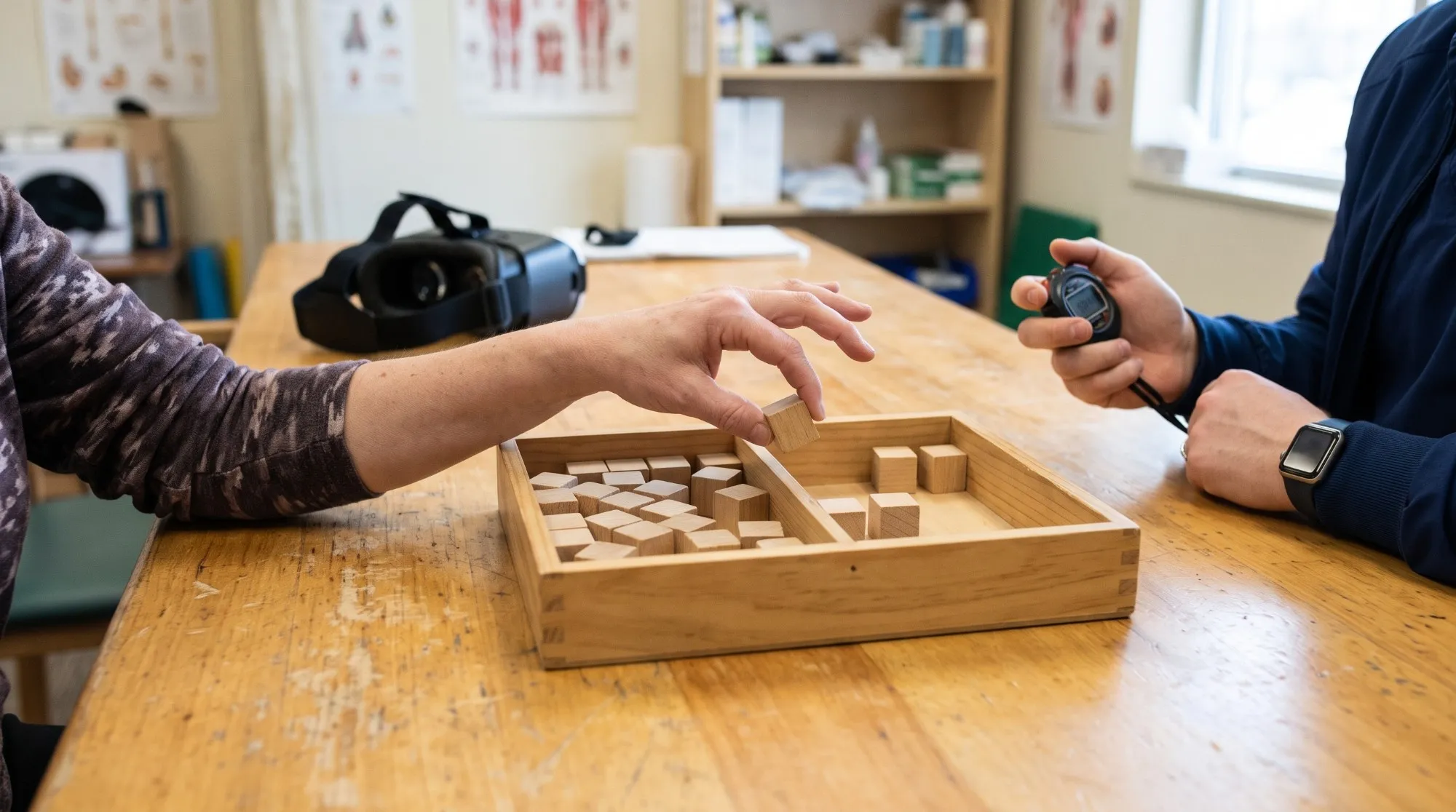
- Box and Block Test (gross). The person moves wooden blocks one at a time over a partition. The score is the number of blocks moved in 60 seconds, and higher is better [2].
- Nine-Hole Peg Test (fine). Nine pegs are placed in a board and then removed as quickly as possible. The score is time in seconds, and lower is better [3,4].
- Purdue Pegboard (fine). Pins are placed in a row of holes within a fixed time with the right hand, the left hand and both hands, followed by an assembly task with pins, washers and collars. Scores are counts [5].
- Jebsen-Taylor Hand Function Test (functional). Seven timed subtests simulate everyday tasks: writing, turning cards, picking up small objects, simulated feeding, stacking checkers, and moving large light and large heavy objects. Scores are in seconds [6].
- Action Research Arm Test (arm and hand activity). Nineteen items in four subtests (grasp, grip, pinch and gross movement), each scored 0–3, give a total of 0–57 points [7]. It measures hand use within whole-arm tasks rather than dexterity on its own.
Units matter: a result in blocks can only be judged against a threshold in blocks.
The study
- Design: systematic review with meta-analysis, registered in PROSPERO, published in the Journal of Clinical Medicine [1]. The meta-analysis included only randomised controlled trials. The wider review also included pilot, feasibility and observational studies.
- Search: Web of Science, Scopus and PubMed, English-language studies published before “10/12/2024”.
- Included studies: 23 studies with 395 patients, 195 of them in control groups. Thirteen trials entered the meta-analysis; the review does not report how many participants they contributed.
- Population: people after stroke with upper limb impairment. The eligibility criteria set no age limit (the abstract says adults) and excluded studies of patients with comorbidities or with healthy controls. Mean age was 52 years (SD 15). Most studies involved chronic stroke (52%), followed by subacute stroke (35%).
- Intervention: imVR through a head-mounted display; non-immersive and semi-immersive systems were excluded. Fifteen studies (65%) used hand tracking.
- Comparator: conventional rehabilitation, not defined further.
- Outcomes: the Fugl-Meyer Assessment for the Upper Extremity (FMA-UE), the BBT and the ARAT. Only the BBT is a dexterity test, and it measures gross dexterity.
- Dose: medians of 3 weeks, 30 minutes per session and 400 minutes in total.
- Analysis: RoB 2 for risk of bias; mean differences (MD) on each scale, and standardised mean differences (SMD) to compare stroke stages. The authors did not report a GRADE certainty rating.
We worked from the full text in PubMed Central [1].
What it found
| Outcome | MD (95% CI) | Trials | Participants | I² |
|---|---|---|---|---|
| FMA-UE (points) | 3.04 (1.46 to 4.62) | 11 | not reported | 81% |
| BBT (blocks) | 2.85 (0.70 to 4.99) | 5 | not reported | 93% |
| ARAT (points) | 3.47 (−0.22 to 7.15) | 3 | not reported | 97% |
FMA-UE. The result favoured imVR (p < 0.001) [1].
BBT. The authors report: “A statistically significant difference was found in favor of imVR (MD = 2.85, 95% CI [0.70; 4.99], p = 0.009)” [1].
ARAT. No statistically significant difference (p = 0.06). This neither shows a benefit nor shows that the two approaches are equivalent.
Stroke stage. Both the subacute subgroup (SMD 0.92, 0.48 to 1.36; 7 studies) and the chronic subgroup (SMD 0.69, 0.03 to 1.35; 6 studies) favoured imVR. The difference between stages was not statistically significant (p = 0.58) [1].
Dose. In meta-regression, longer sessions and longer total treatment were associated with larger effects in chronic stroke (p = 0.016 and p = 0.025) but not in subacute stroke. The authors call these “preliminary insights” [1].
Robustness. Egger’s test did not suggest publication bias (p = 0.08), and no single study had an extreme influence in a leave-one-out analysis [1].
Is it a clinically meaningful change?
Thresholds such as the SRD and the MCID describe change in one person. The 2.85-block figure is a difference between two group averages, so it cannot tell us how many patients changed meaningfully, or that none did.
The smallest real difference (SRD) is about measurement error. Chen and colleagues tested 62 people after stroke twice, 3 to 7 days apart. For the BBT, the SRD was 5.5 blocks per minute for the more affected hand and 7.8 for the less affected hand [4]. A smaller individual change may be measurement noise.
The minimal clinically important difference (MCID) is the smallest change patients judge worthwhile. Kenea and colleagues conclude that “these improvements did not reach clinically significant thresholds (7 points for FMA-UE and 6 points for BBT)” [1]. We report 6 blocks as the threshold the authors applied.
Even the upper limit of the confidence interval (4.99 blocks) is below both thresholds, but this compares scales, not individual patients. An average gain of under three blocks is compatible with some patients gaining well over six and others gaining nothing, and the review does not report that spread. The figure is also the extra gain over conventional rehabilitation, not the total change: people in both arms received therapy.
How to interpret and apply the findings
What the evidence supports:
- Headset-based imVR gave small average extra gains over conventional rehabilitation on the FMA-UE and on gross dexterity (BBT), below the thresholds the authors used for clinical significance.
- For arm and hand activity on the ARAT, the review did not show an added benefit.
- There is no pooled estimate for fine dexterity, so the review neither supports nor rules out an effect on finger control.
- The authors recommend imVR as a complement, not a standalone solution [1]. The dose signal is preliminary.
Our suggestions for integrating imVR well. These are editorial guidance based on general rehabilitation practice. The studies did not test them.
- Set the hand goal first, for example grasp and release or finger control, and choose VR tasks that practise it.
- Check whether the patient can hold and operate a controller. The authors note that controllers can be hard to use early after stroke; hand tracking is an alternative, but the review could not compare the two.
- Fit VR into the upper limb programme alongside practice with real objects.
- Measure with the test that matches the goal: the BBT for gross dexterity, the Nine-Hole Peg Test for fine dexterity. On the BBT, treat a change of less than about 5.5 blocks in the more affected hand as possible measurement noise [4].
Our guide to choosing a VR rehabilitation system covers adaptation, supervision and monitoring.
Limitations to keep in mind. I² values of 81–97% mean the trials disagree substantially, and the BBT analysis rests on five small trials, the largest with 52 participants. According to the review’s reference list, one of the five BBT trials and one of the three ARAT trials enrolled people with spinal cord injury rather than stroke [8], and the studies cited for the stroke-stage subgroups include non-randomised studies and a trial protocol, so we give those subgroup estimates less weight. The comparator is not defined and the review does not report whether therapy time was matched. The 2025 Cochrane review, covering all types of VR, found a smaller upper limb effect when VR replaced other therapy (SMD 0.20, low certainty) than when it was added to usual care (SMD 0.42, moderate certainty; its authors’ ratings) [9]. Programmes were short, no pooled follow-up was reported, and several trials were not at low risk of bias in some RoB 2 domains (only 9 of 13 for deviations from intended interventions). The results concern imVR as a category, not any specific product. The authors declare no conflicts of interest, and the work was funded by the NASCERE project (Jimma University and Hasselt University, supported by VLIR-UOS) [1].
Bottom line for clinicians
- Supported benefit: after stroke, headset-based imVR added a small average gain in gross dexterity (Box and Block Test) over conventional rehabilitation, below the thresholds for individual change; fine dexterity has no pooled evidence yet.
- Integration opportunity: use imVR as a complement within the upper limb programme, for grasp-and-release practice that you match to the patient’s hand goal and grip ability.
- Your role: setting the goal, choosing and progressing the tasks, and checking each patient’s response against the BBT or Nine-Hole Peg Test is what turns headset practice into hand rehabilitation.
For the wider stroke evidence, see What the 2025 Cochrane review says about VR after stroke, and for how VR types differ, our guide to VR in rehabilitation.
References
- Kenea CD, Abessa TG, Lamba D, Bonnechère B. Immersive virtual reality in stroke rehabilitation: a systematic review and meta-analysis of its efficacy in upper limb recovery. J Clin Med. 2025;14(6):1783. doi:10.3390/jcm14061783 · PubMed 40142592 · Full text (PMC11943060)
- Mathiowetz V, Volland G, Kashman N, Weber K. Adult norms for the Box and Block Test of manual dexterity. Am J Occup Ther. 1985;39(6):386–391. doi:10.5014/ajot.39.6.386
- Kellor M, Frost J, Silberberg N, Iversen I, Cummings R. Hand strength and dexterity. Am J Occup Ther. 1971;25(2):77–83. PMID 5551515
- Chen HM, Chen CC, Hsueh IP, Huang SL, Hsieh CL. Test-retest reproducibility and smallest real difference of 5 hand function tests in patients with stroke. Neurorehabil Neural Repair. 2009;23(5):435–440. doi:10.1177/1545968308331146
- Tiffin J, Asher EJ. The Purdue pegboard: norms and studies of reliability and validity. J Appl Psychol. 1948;32(3):234–247. doi:10.1037/h0061266
- Jebsen RH, Taylor N, Trieschmann RB, Trotter MJ, Howard LA. An objective and standardized test of hand function. Arch Phys Med Rehabil. 1969;50(6):311–319. PMID 5788487
- Lyle RC. A performance test for assessment of upper limb function in physical rehabilitation treatment and research. Int J Rehabil Res. 1981;4(4):483–492. doi:10.1097/00004356-198112000-00001
- Lim DY, Hwang DM, Cho KH, Moon CW, Ahn SY. A fully immersive virtual reality method for upper limb rehabilitation in spinal cord injury. Ann Rehabil Med. 2020;44(4):311–319. doi:10.5535/arm.19181
- Laver KE, Lange B, George S, et al. Virtual reality for stroke rehabilitation. Cochrane Database Syst Rev. 2025;6:CD008349. doi:10.1002/14651858.CD008349.pub5
Frequently asked questions
What is a clinically meaningful change on the Box and Block Test?
In people after stroke, Chen and colleagues (2009) reported a smallest real difference of 5.5 blocks per minute for the more affected hand and 7.8 for the less affected hand, and Kenea and colleagues (2025) applied a 6-block threshold. The pooled immersive VR gain of 2.85 blocks (95% CI 0.70 to 4.99) is below both, but both are thresholds for individuals, while the pooled figure is a group average.
Does immersive VR improve hand dexterity after stroke?
In a 2025 meta-analysis, immersive VR was associated with a small average gain over conventional rehabilitation on the Box and Block Test (MD 2.85 blocks, 95% CI 0.70 to 4.99; 5 trials; I² 93%), below the thresholds used to judge change in an individual. Fine dexterity was not pooled, the ARAT difference was not statistically significant and the authors give no GRADE rating.
How is the Nine-Hole Peg Test scored?
The Nine-Hole Peg Test measures fine dexterity: the person places nine pegs in a board and then removes them, and the score is the time in seconds, with lower being better. The 2025 meta-analysis by Kenea and colleagues did not pool this test, so it gives no effect estimate for fine finger control.
What is the difference between gross and fine dexterity tests?
Gross dexterity tests such as the Box and Block Test count how often the whole hand grasps, carries and releases an object, while fine dexterity tests such as the Nine-Hole Peg Test time precise finger and thumb control. The 2025 meta-analysis pooled only the Box and Block Test (5 trials), so it gives no pooled estimate for fine dexterity.
What does an I² of 93% mean in a meta-analysis?
I² estimates how much of the variation between trials reflects real differences rather than chance. An I² of 93% for the Box and Block Test (97% for the ARAT) means the trials disagree substantially, so the pooled average of 2.85 blocks may hide a wide range of results and should be read with caution.