What the 2025 Cochrane review says about VR after stroke
190 trials, two very different comparisons and certainty from very low to moderate. What the 2025 Cochrane review of VR for stroke rehabilitation shows.
The main finding
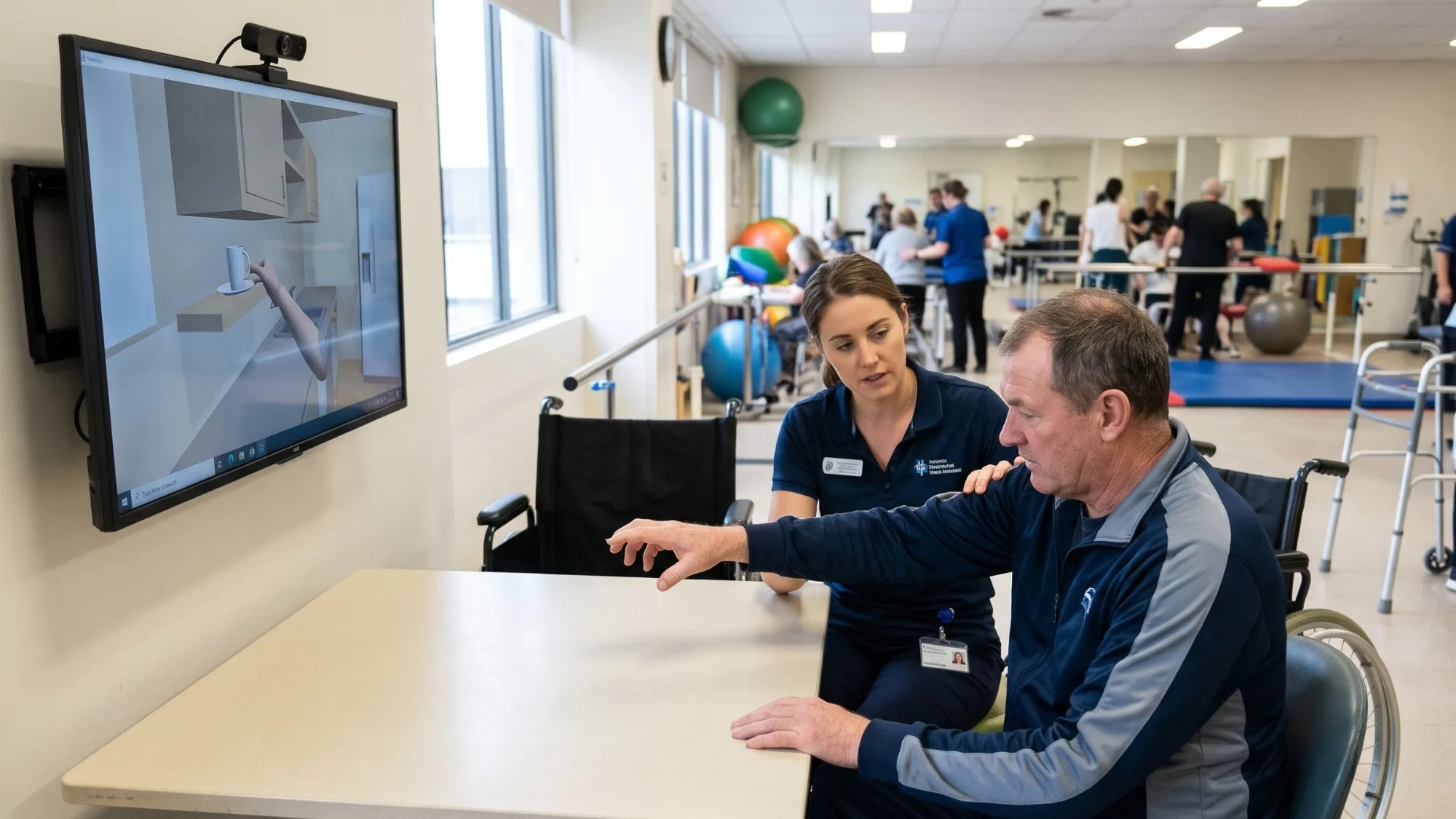
Used instead of another therapy at the same dose, virtual reality may slightly improve arm function after stroke. That is the central result of the 2025 Cochrane review by Laver and colleagues [1]. The effect was small (SMD 0.20) and the authors rate the evidence low certainty. Added to usual care, VR gave a larger estimate (SMD 0.42, moderate certainty), but those patients also had more therapy time.
For clinicians, the practical reading is the authors’ own: VR can be a useful part of a comprehensive programme, chosen for the patient’s goals, abilities and preferences, although the review does not show which kind of programme works best [1]. Our four-minute video summary of this review covers the same ground.
The study
- Design: Cochrane systematic review with meta-analysis, published on 20 June 2025, updating the 2017 version [1].
- Trials: 190 randomised trials with 7,188 adults after stroke, searched to September 2023. Only 36 had more than 50 participants.
- Intervention: VR and interactive video gaming under a broad 2001 definition, covering commercial consoles and rehabilitation systems. Very few trials used immersive VR such as headsets.
- Comparisons, analysed separately: VR instead of an alternative therapy, usually at the same dose; and VR added to usual care.
- Outcomes: upper limb function and activity (the critical outcome), plus balance, gait speed, activity limitation, participation and quality of life, and adverse events, at the end of treatment.
- Certainty: rated by the authors with GRADE. We report their ratings, and worked from the open-access full text [1].
What it found
Effects are standardised mean differences (SMD), except gait speed (mean difference, MD). The authors treat SMDs of 0.2 to 0.5 as small.
| Outcome and comparison | Effect (95% CI) | Trials | Participants | Certainty (authors) |
|---|---|---|---|---|
| Upper limb: VR vs alternative therapy | SMD 0.20 (0.12 to 0.28) | 67 | 2,830 | Low |
| Upper limb: VR added to usual care | SMD 0.42 (0.26 to 0.58) | 21 | 689 | Moderate |
| Balance: VR vs alternative therapy | SMD 0.26 (0.12 to 0.40) | 24 | 871 | Low |
| Balance: VR added to usual care | SMD 0.68 (0.46 to 0.91) | 12 | 321 | Low |
| Activity limitation: VR vs alternative therapy | SMD 0.21 (0.11 to 0.32) | 33 | 1,495 | Moderate |
| Activity limitation: VR added to usual care | SMD 0.22 (0.04 to 0.41) | 15 | 513 | Moderate |
| Participation and quality of life: VR vs alternative therapy | SMD 0.11 (−0.02 to 0.24) | 16 | 963 | Low |
| Gait speed: VR vs alternative therapy | MD 0.05 (−0.02 to 0.13) | 10 | 304 | Very low |
Upper limb function. Against an alternative therapy, VR may slightly improve arm function. Certainty is low because many trials had an unclear risk of bias and results varied widely (I² = 68%). Added to usual care, the estimate is about twice as large, but the VR group gets extra therapy time and the control group does not, so it mixes whatever VR adds with the effect of more practice. The same-dose comparison is the one that isolates VR.
Other outcomes. VR may slightly improve balance and probably reduces activity limitation. For participation and quality of life, and for gait speed, there was no clear benefit. That does not make VR and the alternative therapies equivalent on those outcomes.
Safety. In the 59 trials that monitored adverse events, they were few and mild: short-lived dizziness, headache or pain. The authors judge they may be similar with VR and alternative therapy [1]. The other 131 trials did not report monitoring them.
Subgroups and sensitivity. For arm function:
- Programmes of 15 hours or more showed a larger effect (SMD 0.30) than shorter ones (SMD 0.13), a statistically significant difference.
- Rehabilitation systems and commercial games did not differ significantly, nor did trials within or beyond six months of stroke.
- Immersive rehabilitation systems showed a larger effect (SMD 0.68), but there were so few that the authors draw no conclusions about headsets.
- Limited to the 17 trials without unclear or high risk of bias in two or more domains, the benefit was no longer seen (SMD 0.04, 95% CI −0.09 to 0.16).
How to interpret and apply the findings
What the evidence supports:
- At the same dose, VR may give a small improvement in arm function (low certainty) and probably reduces activity limitation (moderate certainty). Added to usual care, extra VR time probably improves arm function.
- Longer programmes showed larger arm effects. The type of system made no significant difference.
Our suggestions for integrating VR well. These are editorial guidance based on general rehabilitation practice. The studies did not test them.
- Set the therapeutic goal first, for example reaching or grasp, and choose tasks that train it.
- Where VR can add practice time alongside supervised sessions, consider using it that way.
- Adjust difficulty from your own assessment, and reassess with the scale you use in clinic, such as the Fugl-Meyer Assessment or the Action Research Arm Test.
Our guide to choosing a VR rehabilitation system covers the implementation side: adaptation, supervision, monitoring and day-to-day use. We compare formats in Immersive vs non-immersive VR.
Limitations to keep in mind. Most trials were small and poorly reported, and the arm benefit was not seen in the better-quality trials. “VR” covers very different interventions, doses and measures; Wade’s accompanying editorial sees this breadth as a major source of uncertainty [2]. Results describe mostly screen-based VR, few trials had longer-term follow-up, and the search ended in September 2023. The review had no dedicated funding. Two authors each wrote two included trials and did not assess them; one holds VR rehabilitation patents, and another author consults on developing rehabilitation tools [1].
Bottom line for clinicians
- Supported benefit: at the same dose, VR may slightly improve arm function after stroke (low certainty) and probably reduces activity limitation (moderate certainty). Added to usual care, extra VR time probably improves arm function.
- Integration opportunity: VR can add goal-directed arm practice to a programme, ideally for 15 hours or more, using a rehabilitation system or a commercial game chosen for the movement it trains.
- Your role: the review does not show that any particular system works. Matching the task to the patient’s goals, progressing it and checking the response with your usual measures is what makes VR practice part of rehabilitation.
For hand dexterity specifically, see VR and hand dexterity after stroke: is the gain clinically meaningful?, and for the wider picture, our guide to VR in rehabilitation.
References
- Laver KE, Lange B, George S, Deutsch JE, Saposnik G, Chapman M, Crotty M. Virtual reality for stroke rehabilitation. Cochrane Database Syst Rev 2025;6:CD008349. DOI: 10.1002/14651858.CD008349.pub5 · PubMed 40537150 · Full text (PMC12178777)
- Wade DT. Virtual reality for stroke rehabilitation: time to rethink? Lessons from a Cochrane review. Cochrane Database Syst Rev 2025;7:ED000174. DOI: 10.1002/14651858.ED000174
Frequently asked questions
Does VR improve arm function after stroke?
It may help slightly. Compared with alternative therapy at the same dose, the 2025 Cochrane review found a small improvement in upper limb function (SMD 0.20, 95% CI 0.12 to 0.28; low certainty). Added to usual care, the estimate was larger (SMD 0.42; moderate certainty), but those patients also received more therapy time.
What does low certainty mean in a Cochrane review?
Cochrane reviews rate the certainty of each result with GRADE: high, moderate, low or very low. Low certainty means the true effect may be substantially different from the estimate. Moderate certainty means the true effect is probably close to the estimate, but could still be substantially different.
Why is the effect larger when VR is added to usual care?
In add-on trials the VR group usually receives extra therapy time on top of usual care, while the control group does not. The larger effect may therefore reflect more practice as well as VR itself, and the review cannot separate the two.
Is VR rehabilitation safe after stroke?
In the 59 trials that monitored adverse events, they were few and mild: short-lived dizziness, headache or pain, and the authors judge they may be similar with VR and alternative therapy. The other 131 trials did not report monitoring adverse events, so the safety data are incomplete.
Does the Cochrane review show that a specific VR system works?
No. The review pools many different systems, from commercial video games to purpose-built rehabilitation platforms, and does not report results for any specific commercial product. Rehabilitation-specific systems and commercial games did not differ significantly for arm function.