Home exercise apps with motion tracking: do patients do more, and do they get better?
Recent randomised trials of home exercise apps with camera or sensor tracking in shoulder, hand, hip and knee rehab: what they did for adherence and outcomes.
Disclosure: Tech in Rehab is developed with contributions from professionals employed by Rehametrics, which sells rehabilitation technology. Rehametrics provides no direct financial funding. Rehametrics does not make any of the apps named in this article, and none of them are scored.
The main finding
Digital home exercise programmes help patients do more of their exercises. When the app also tracks the movement and corrects it in real time, the extra practice has turned into better results. In randomised trials from 2025 and 2026, adding a motion-tracking app to physiotherapy reduced shoulder pain, sped up recovery of finger range of motion after hand injuries, and improved hip scores after hip replacement [4,7,8]. In knee osteoarthritis, an app that encouraged exercise without tracking movement doubled full adherence, with no significant difference in function [3].
For clinicians, this points to a specific use: an app that measures how the exercise is done, added to the programme to extend practice into the days between sessions. Our four-minute video explains the same evidence in plain language.
Why home exercise is the target
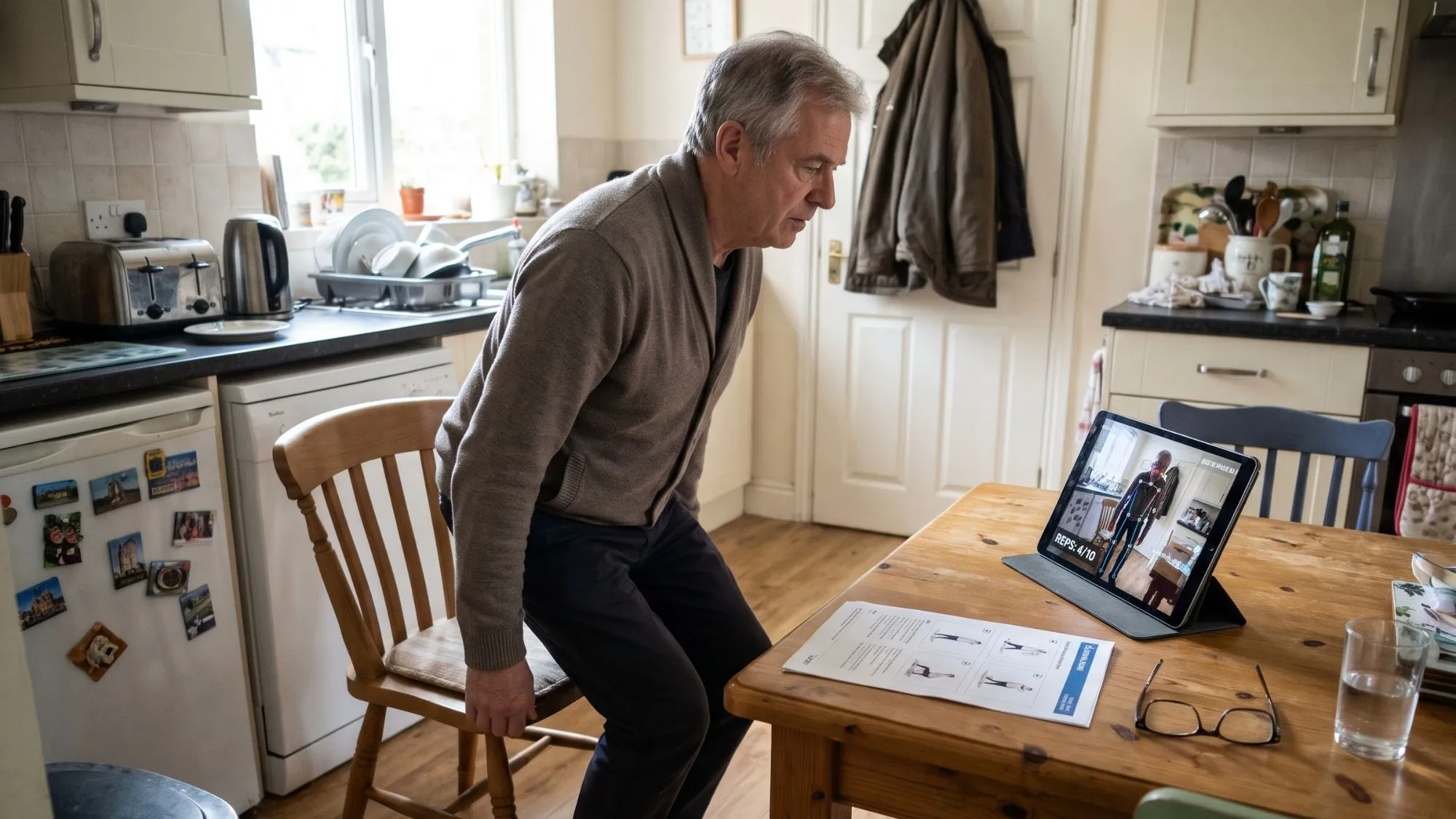
Most rehabilitation practice happens at home, between visits. A systematic review of home-based physiotherapy reported non-adherence as high as 70% [1]. A paper handout can’t tell the therapist whether the patient did three sets or none, or lifted the arm to 90 degrees or stopped at 60. Apps with motion tracking use the phone camera, with computer vision that estimates joint positions, or small wearable sensors on the limb. They can count repetitions, measure range of motion, give feedback during the exercise and send a log to the therapist.
Do patients do more?
Pooled evidence. Zhang and colleagues pooled 11 randomised trials with 1,144 people with musculoskeletal conditions [2]. At intermediate follow-up, digital programmes improved adherence to prescribed exercise compared with non-digital programmes (6 trials, SMD 0.53, 95% CI 0.35 to 0.70). At short and long-term follow-up the differences were not statistically significant, but those analyses included only two or three trials each, so they can’t tell us whether the effect holds.
Recent trials:
- In 182 people with knee osteoarthritis, an app with exercise tracking, goal-setting and behaviour change messages doubled the chance of full adherence at 26 weeks: 36% against 16% (relative risk 2.1, 95% CI 1.4 to 3.2) [3]. This app did not track movement.
- After hip replacement, 240 patients followed the same 12-week app programme with or without wearable sensors. The sensor group completed more exercise sessions and took part more in weekly assessments and follow-up calls [4].
- In 31 patients with thumb problems, home exercises done as mobile games improved adherence, recorded on a home exercise log [5].
Usability matters. In a Thai trial of 40 older adults without knee problems, a motion-analysis app led to lower compliance than standard instructions. Users found it hard to use and unstable [6].
Do they get better?
| Trial | Condition | Participants | App | Main result |
|---|---|---|---|---|
| Villar-Alises 2026 [7] | Rotator cuff-related shoulder pain | 46 | Camera-based, AI feedback, added to physio | Less pain at 2 and 4 weeks; better QuickDASH at 4 weeks; fewer needed further care (3 vs 10) |
| Bauknecht 2025 [8] | Finger fractures and tendon injuries | 112 | Camera-based ROM tracking, added to hand therapy | More reached the 40° MCID: 79% vs 54% at 6 weeks, 50% vs 26% at 12 weeks |
| Jiang 2026 [4] | Total hip replacement | 240 | Same app ± wearable sensors | Better HOOS at 24 weeks, below the MCID; similar costs |
| Jung 2025 [9] | Total knee replacement | 49 | Wearable sensor + app vs supervised self-directed rehab | Less pain and stiffness, better function in the early weeks |
| Hinman 2026 [3] | Knee osteoarthritis | 182 | Tracking and messages, no motion tracking | Better adherence; no significant difference in function |
| Lin 2026 [10] | Adhesive capsulitis (pilot) | 30 | Gamified phone programme, added to physio | No detectable difference; intervals too wide to judge |
Shoulder. In a Spanish trial of 46 adults with rotator cuff-related shoulder pain, adding a camera-based app with real-time feedback to physiotherapy reduced pain more at 4 weeks (−1.0 points on a 0–10 scale) and improved the QuickDASH by 7.3 more points [7]. Fear-avoidance beliefs fell more by 12 weeks, and fewer people in the app group needed further care afterwards.
Hand. In a German trial of 112 patients after finger fractures or tendon injuries, a camera-based app was added to 18 sessions of hand therapy for 12 weeks [8]. At 6 weeks, 79% of app users had gained the 40-degree minimal clinically important difference in range of motion, against 54% of controls.
Hip replacement. This trial isolates the tracking itself: both groups had the same app, exercises and weekly calls, and only the sensors differed [4]. The sensor group scored better on the HOOS at 24 weeks, with better quality of life and mood scores, at about the same cost. The HOOS difference was below the minimal clinically important difference.
Knee replacement. In 49 women aged up to 70, rehabilitation with a wearable tracker and app reduced pain and stiffness in the early weeks more than self-directed rehabilitation with physiotherapist supervision and outpatient visits [9].
Knee osteoarthritis and adhesive capsulitis. Better adherence in the osteoarthritis trial came with no significant difference in function [3]. The capsulitis pilot was too small to detect or rule out a clinically meaningful effect [10].
How to interpret and apply the findings
What the evidence supports:
- Digital programmes can improve adherence to home exercise, at least at intermediate follow-up.
- Apps that track movement and give feedback, added to physiotherapy, improved pain, range of motion or joint-specific scores in shoulder, hand and hip trials.
- In the one trial that isolated the sensors, they improved adherence and hip scores at no extra cost.
- Better adherence without movement tracking did not improve function in knee osteoarthritis.
Our interpretation and suggestions. This is editorial guidance. The trials did not test it directly.
- The trials with better outcomes all measured how the movement was done. Our reading is that feedback on quality, not only reminders to exercise, is what turns extra practice into better results.
- Prescribe the app as part of the programme, with the same goals and progression you set in clinic.
- Try the app yourself first, and check the patient can use it at home.
- Review the logs between sessions. In the capsulitis pilot, recorded engagement ranged from 7% to 96% between patients [10], which a paper diary would not show.
Our guide to choosing a VR rehabilitation system covers data, reporting and ease of use, and most of it applies to home exercise apps.
Limitations. Most trials were small and single-centre, with follow-up of 12 to 26 weeks. Except in the hip trial, the app was added to usual care, so the app groups may also have exercised more in total. Patients knew their group, and pain and function were self-reported. Each trial tested one app. We checked the full text of the hand, hip, knee replacement, Thai app and capsulitis trials, and relied on the abstracts for the others.
Bottom line for clinicians
- Supported benefit: apps that track movement and give real-time feedback, added to physiotherapy, have improved pain, range of motion and joint scores in shoulder, hand and hip rehabilitation.
- Integration opportunity: use a tracking app to extend practice between sessions, especially when range of motion or exercise quality is the goal.
- Your role: you set the exercises and targets, check the data and adjust the plan. That is what turns logged repetitions into a rehabilitation programme.
References
- Essery R, Geraghty AW, Kirby S, Yardley L. Predictors of adherence to home-based physical therapies: a systematic review. Disabil Rehabil 2017;39(6):519-534. DOI: 10.3109/09638288.2016.1153160 · PubMed 27097761
- Zhang ZY, Tian L, He K, et al. Digital rehabilitation programs improve therapeutic exercise adherence for patients with musculoskeletal conditions: a systematic review with meta-analysis. J Orthop Sports Phys Ther 2022;52(11):726-739. DOI: 10.2519/jospt.2022.11384 · PubMed 35960507
- Hinman RS, Nelligan RK, Campbell PK, et al. Mobile app to support home exercise adherence in knee osteoarthritis: a randomized clinical trial. Osteoarthritis Cartilage 2026;34(4):631-640. DOI: 10.1016/j.joca.2025.12.012 · PubMed 41418994
- Jiang C, Shen Y, Huang L, Ma Y, Lu S, Yin J. The efficiency and cost-effectiveness of wearable sensors in a digital physiotherapeutic total hip arthroplasty-specific training system for patients after total hip arthroplasty: randomized controlled trial. JMIR Mhealth Uhealth 2026;14:e93050. DOI: 10.2196/93050 · PubMed 42479868
- Özer C, Karaçam S, Kaya Z, Alkan H. Effects of home exercise-based mobile games on thumb rehabilitation outcomes. Hand Ther 2025. DOI: 10.1177/17589983251387079 · PubMed 41199750
- Sornmayura P, Pattanakuhar S, Intapan N, et al. Effects of an exercise-assisting mobile app (Osteoarthritis-Rehabilitation Assistant [O-RA]) on rehabilitation outcomes in older adults: randomized controlled parallel clinical trial. JMIR Rehabil Assist Technol 2026;13:e80971. DOI: 10.2196/80971 · PubMed 41985075
- Villar-Alises O, Cortés CC, Rodríguez-Piñero Durán M, Sánchez-Laulhé PR, Martinez-Calderon J, Suero-Pineda A. Effectiveness of an AI-based home exercise app for rehabilitation of rotator cuff-related shoulder pain: a randomized controlled trial. Musculoskelet Sci Pract 2026;85:103626. DOI: 10.1016/j.msksp.2026.103626 · PubMed 42531919
- Bauknecht S, Moeller R, Mentzel M, Lebelt M, Mack J, Vergote D. Physiotherapy in your pocket: effectiveness of home exercises using an AI-based smartphone app for the postoperative follow-up of hand injuries. A randomized, controlled, open-label study [in German]. Handchir Mikrochir Plast Chir 2025;57(3):186-194. DOI: 10.1055/a-2599-8250 · PubMed 40602395
- Jung SJ, Kim JH, Rhee SJ. Home-based rehabilitation using wearable motion tracker with smart phone application feedback is as effective as conventional self-directed rehabilitation after total knee arthroplasty: randomized controlled trial. BMC Sports Sci Med Rehabil 2025;17(1):370. DOI: 10.1186/s13102-025-01374-1 · PubMed 41444603
- Lin HW, Hu CC, Yen HM, Kang JH. Low-supervision asynchronously monitored home rehabilitation for adhesive capsulitis: a pilot randomized study. Life (Basel) 2026;16(9):1551. DOI: 10.3390/life16091551 · PubMed 42795415
Frequently asked questions
Do home exercise apps improve adherence?
The evidence points that way. A 2022 meta-analysis of 11 trials (1,144 people with musculoskeletal conditions) found better adherence with digital programmes at intermediate follow-up (SMD 0.53, 95% CI 0.35 to 0.70). At short and long-term follow-up the difference was not statistically significant, with few trials in those analyses. In a 2026 knee osteoarthritis trial, 36% of app users were fully adherent at 26 weeks, against 16% without the app.
Does better adherence to home exercise mean better outcomes?
Not automatically. In the 2026 knee osteoarthritis trial the app doubled the chance of full adherence, with no significant difference in function. In trials where the app also tracked movement and gave feedback, such as a 2026 shoulder trial and a 2025 hand trial, outcomes improved more than with physiotherapy alone.
How do apps track exercise at home?
Most use either the smartphone camera, with computer vision that estimates joint positions, or small wearable motion sensors strapped to the limb. Both can count repetitions, measure range of motion and tell the patient in real time whether a movement was done correctly. The data can also be shared with the therapist.
Should a home exercise app replace physiotherapy sessions?
The current trials don't answer that. In almost all of them the app was added to standard physiotherapy, so they show what an app adds, not what happens if it replaces the therapist.