Markerless Motion Capture: How a Camera Measures Movement
How camera-based motion tracking works without body markers, what it measures accurately, where it falls short, and how to judge a system's claims.
The short answer
A camera and the right software can now measure some aspects of movement well enough to be clinically useful. Walking speed, step length and step time agree closely with laboratory marker-based systems [2]. Single depth cameras measure shoulder flexion and abduction with good to excellent validity in most studies [3]. Accuracy drops for rotations, for the ankle and for complex movements that combine several joints [2][3].
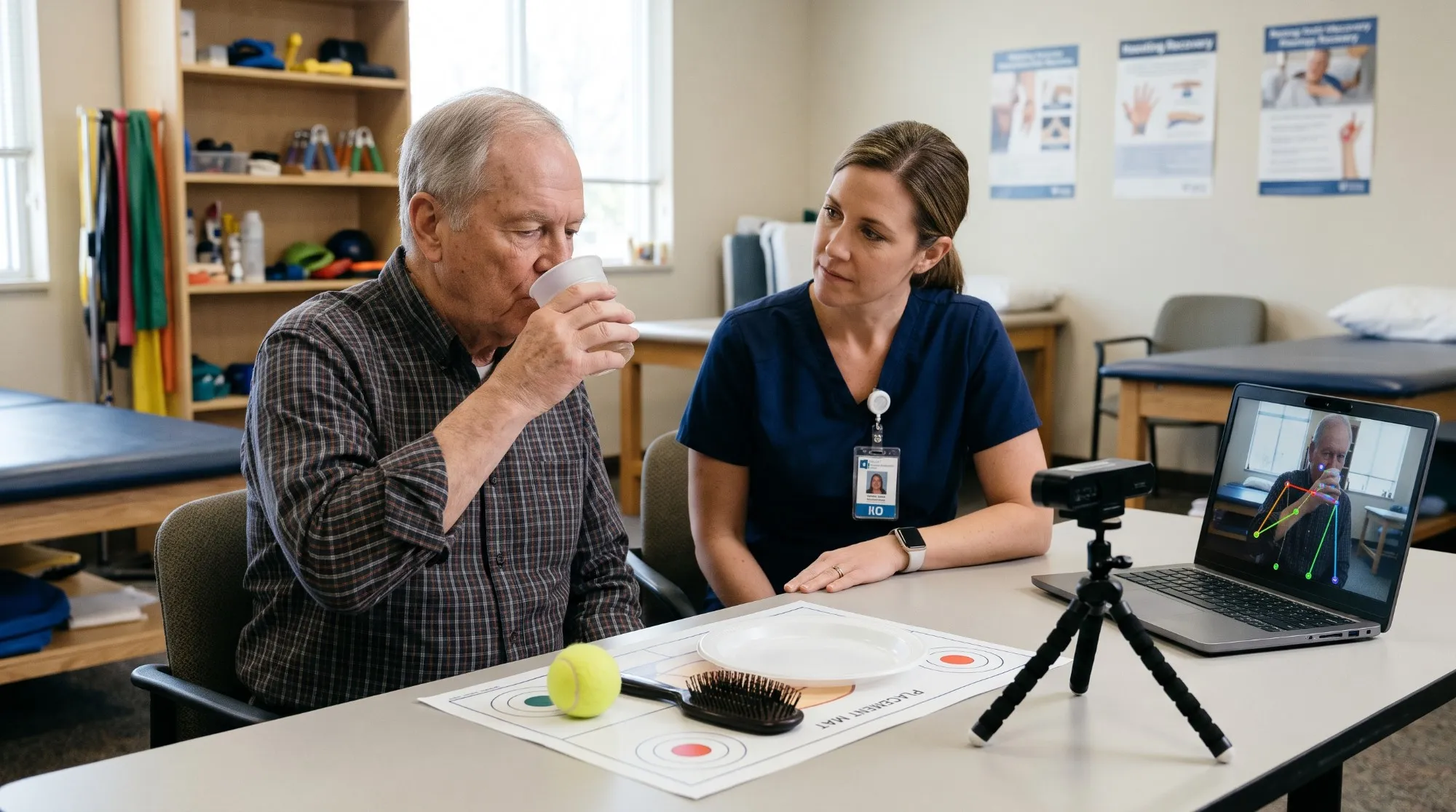
Turning those measurements into a clinical score is a further step, and the evidence there is earlier. In a 2026 development study, a single camera matched occupational therapists’ ratings of arm tasks after stroke in 75% to 92% of attempts, depending on the task. The authors state it is not ready for clinical use [4]. Most validation has been done in healthy adults, so results in patients should be checked rather than assumed [1][2].
How it works
Traditional laboratory motion capture places reflective markers on the skin and tracks them with several infrared cameras. Markerless systems skip the markers. They record ordinary video and use software, usually a trained machine learning model, to estimate where the joints are in each frame. This is called pose estimation.
From the estimated joint positions, the system calculates what clinicians care about: joint angles, range of motion, movement speed, smoothness, trunk movement, step length or the number of repetitions.
There are two main hardware approaches:
| Approach | What it records | Typical example | Practical note |
|---|---|---|---|
| Colour (RGB) video | A normal 2D image | Phone, tablet or webcam | No extra hardware; depth has to be estimated by the software |
| Depth (RGB-D) camera | Colour plus the distance of each point from the camera | Kinect, Azure Kinect, Intel RealSense | Measures depth directly; needs a dedicated camera |
Systems can also use one camera or several. Several cameras see the body from different angles, so joints hidden in one view are visible in another. A single camera is cheaper and quicker to set up, but a limb can block the view of another, which reduces accuracy [3].
Microsoft Kinect, the most common camera in the clinical studies, went out of production in 2017 [1]. That matters when reading older research: the hardware tested may no longer be available.
How accurate is it?
Accuracy depends on what is being measured. Three systematic reviews give the clearest picture.
| What is measured | What the reviews found |
|---|---|
| Walking speed, step length, step time | Good to excellent agreement with marker-based systems (pooled ICC 0.81 to 0.98) [2] |
| Hip and knee angles in the sagittal plane (bending and straightening) | Moderate to excellent agreement [2] |
| Ankle angles | Poor validity and reliability [2] |
| Rotations about the long axis of a limb | Poor agreement for all joints [2]; lower validity at the shoulder [3] |
| Shoulder flexion and abduction (single depth camera) | Good to excellent validity in most studies [3] |
| Complex shoulder movements, such as hair combing or wheelchair transfers | Consistently poor results [3] |
Gait. Scataglini and colleagues reviewed 22 studies comparing markerless camera systems with laboratory marker systems for gait [2]. Spatiotemporal measures performed best. Ankle measurements were the weakest, possibly because footwear and floor contrast make the ankle hard to track. The studies of concurrent validity included 402 healthy people and only 19 patients, all with Parkinson’s disease [2].
Shoulder. Lee and colleagues reviewed 14 studies of single depth cameras measuring shoulder range of motion [3]. Validity was good for simple movements in one plane, but intra-rater reliability was inconsistent even for those. Most studies that reported limits of agreement found discrepancies of more than 10 degrees from the reference. Newer cameras such as Azure Kinect gave more stable results than Kinect V2, but few studies used them [3].
A note on ICC. The intraclass correlation coefficient (ICC) is the usual measure of agreement. Values above 0.75 are generally read as good and above 0.90 as excellent. A high ICC across a group does not guarantee that a single measurement is close to the true value, which is why limits of agreement in degrees are also worth checking.
From measurement to clinical score
Measuring an angle is one task. Judging how well a patient performs a functional task is another, and it is what a clinical scale like the Action Research Arm Test (ARAT) does.
The FULMA study, published in November 2026, tried this with a single depth camera after stroke [4]. Thirty-nine people with stroke and 19 healthy volunteers performed nine everyday arm tasks, such as bringing a cup to the mouth or brushing the back of the head. A machine learning model predicted a three-level score using ARAT descriptors, and its predictions were compared with ratings from two senior occupational therapists.
- Agreement: the best model matched the therapists’ consensus rating 83.3% of the time on average, from 75.0% for moving a cup across the midline to 91.7% for bringing a cup to the mouth. Weighted kappa ranged from 0.67 to 0.88 [4].
- Context: the two therapists agreed with each other at a weighted kappa of 0.85 before reaching consensus [4]. On some tasks the model approached that level; on others it fell short.
- Feedback: the system also produced comments such as slower movement, reduced smoothness or increased trunk movement. The authors present these as exploratory, not as validated clinical descriptions [4].
The authors are clear about the limits. The study took place in a controlled hospital setting with standardised lighting, clothing and camera position. People without voluntary shoulder movement were excluded, because the camera needs active movement to track. Reliability between sessions, measurement error and sensitivity to change were not tested, and the way the models were tuned may make the accuracy figures optimistic [4].
How a system should be validated
A methods paper published in November 2026 sets out a step-by-step workflow for validating an application that uses an ordinary colour (2D) camera to score physical performance tests, including the 30-second sit-to-stand, the Timed Up and Go and gait speed [5]. It includes independent clinician scoring, a rule for deciding when tracking quality is too poor to use, test-retest measurement, a second clinician and testing under deliberately altered recording conditions.
In a pilot with 15 healthy adults and seven tests, 96.7% of recordings made under standard conditions could be analysed, and agreement with the reference ranged from ICC 0.78 to 0.97. Under the altered conditions, 79.6% could be analysed [5]. In other words, about one recording in five failed when conditions were less than ideal, and reporting that failure rate is part of an honest validation.
What the evidence does not show yet
- Performance in patients. Validation is mostly in healthy adults [2]. A review of 65 clinical studies found that most used the technology to tell patients from healthy people or to detect movement features, and only 10 compared its measurements with clinical scales [1].
- Fine hand movement. Kinect-type systems track gross body movement better than fine finger movement [1].
- Severe impairment. People who cannot move a limb actively are hard to track and are often excluded [4].
- Change over time. Few studies test whether the measurements detect real change in a patient, which is what monitoring recovery requires [4].
- Everyday settings. Lighting, background, clothing and camera position all affect accuracy [3][5], and home conditions are less controlled than a laboratory.
How to interpret and apply the evidence
What the evidence supports: camera-based measurement of walking speed and step parameters, and of simple shoulder movements in one plane, with agreement close to established methods in the populations tested [2][3].
Our suggestions for judging a system. These are editorial guidance based on the reviews above. They have not been tested as a checklist.
- Ask what the system was validated against: a marker-based laboratory system, a goniometer or therapist ratings.
- Ask in which population. Results in healthy adults may not hold for your patients.
- Ask for agreement on the specific measure you will use, not an overall accuracy figure. Rotations and complex tasks are usually the weak points.
- Ask how often recordings fail, and under what conditions.
- Check how the system’s scores relate to the scales your service already uses, and keep using those scales while you build confidence in it.
For selection criteria beyond measurement, our guide to choosing a VR rehabilitation system covers adaptation, supervision and day-to-day use. For what camera-tracked home exercise apps have shown in trials, see Home exercise apps with motion tracking.
Bottom line for clinicians
- Supported benefit: a single camera can measure walking speed, step parameters and simple shoulder range of motion with agreement close to laboratory or goniometer measurements, without markers or sensors on the patient.
- Integration opportunity: these measures can add objective, repeatable data to gait and shoulder assessment, in clinic or remotely, alongside your usual scales.
- Your role: choosing which measures to trust, setting up the recording well, checking results that look wrong and interpreting them clinically. Automated scoring of functional tasks is promising but still in development, and therapist judgement remains the reference.
Our video summary covers the same evidence in under five minutes.
References
- Lam WWT, Tang YM, Fong KNK. A systematic review of the applications of markerless motion capture (MMC) technology for clinical measurement in rehabilitation. J Neuroeng Rehabil 2023;20(1):57. DOI: 10.1186/s12984-023-01186-9 · PubMed 37131238
- Scataglini S, Abts E, Van Bocxlaer C, Van den Bussche M, Meletani S, Truijen S. Accuracy, validity, and reliability of markerless camera-based 3D motion capture systems versus marker-based 3D motion capture systems in gait analysis: a systematic review and meta-analysis. Sensors (Basel) 2024;24(11):3686. DOI: 10.3390/s24113686 · PubMed 38894476
- Lee U, Lee S, Kim SA, Kim Y, Lee S. Validity and reliability of single camera markerless motion capture systems with RGB-D sensors for measuring shoulder range-of-motion: a systematic review. Front Bioeng Biotechnol 2025;13:1570637. DOI: 10.3389/fbioe.2025.1570637 · PubMed 40486204
- Fisher J, Bunn C, Li W, Hurden A, Barnhart M, Black R, Anderson C, Chen X. Development of a single-camera markerless motion capture system for assessing upper limb function post-stroke (FULMA). Neurorehabil Neural Repair 2026. DOI: 10.1177/15459683261493918 · PubMed 42973162
- Yue X, Yu B. A reproducible workflow for validating two-dimensional color video-based markerless motion capture for automated physical performance scoring in adults. J Vis Exp 2026;(237). DOI: 10.3791/73504 · PubMed 42980243
Frequently asked questions
What is markerless motion capture?
A way of measuring movement from video without placing markers or sensors on the body. Software estimates the position of the joints in each frame and calculates angles, speeds and distances from them. It can use a normal colour camera, such as a phone's, or a depth camera that also measures distance.
Is it as accurate as a goniometer?
For simple one-plane movements such as shoulder flexion and abduction, studies with single depth cameras report good to excellent agreement. For rotations and complex movements, agreement is much lower, and several studies found differences of more than 10 degrees from the reference [3].
Can a camera score a clinical test like the ARAT automatically?
Not yet in routine practice. A 2026 development study after stroke found 75% to 92% agreement with occupational therapists on an ARAT-anchored score for nine tasks, but the authors state that external validation, reliability testing and sensitivity to change are needed before clinical use [4].
Does it work for patients, or only for healthy people?
Most validation studies were in young, healthy adults [2]. Patient studies exist, especially in Parkinson's disease and stroke [1], but there are far fewer of them, and people with severe impairment are often excluded because the camera needs visible active movement [4].